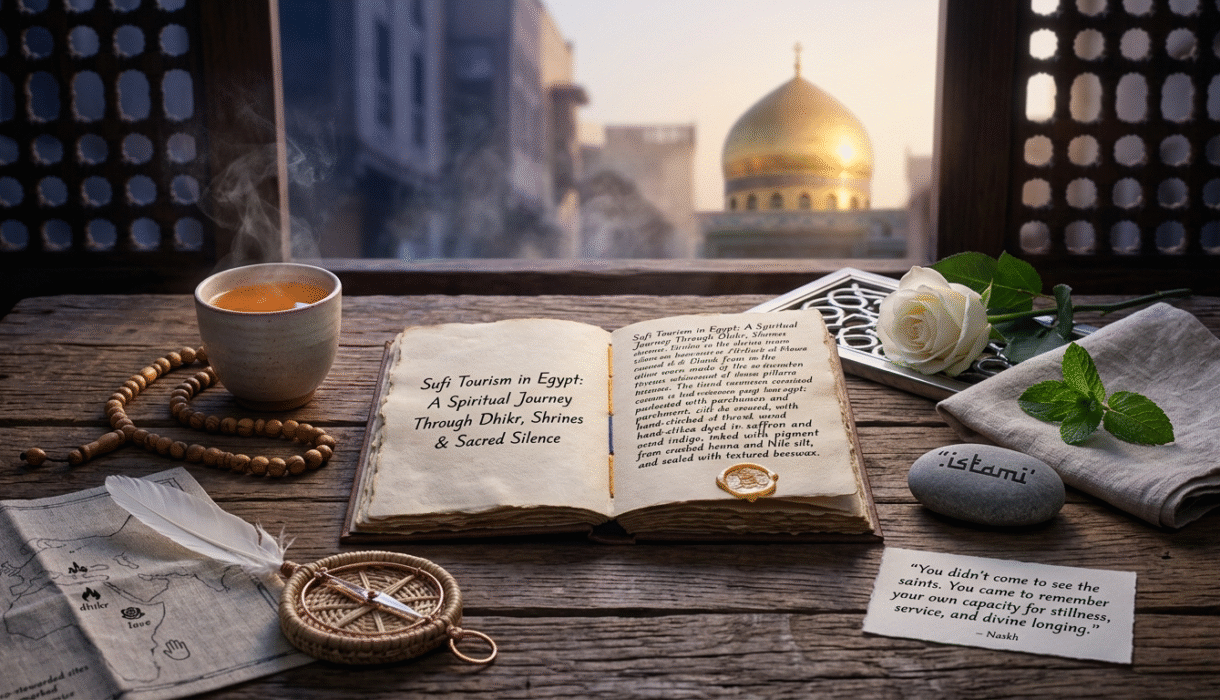
Sufi Tourism in Egypt: A Spiritual Journey Through Dhikr, Shrines & Sacred Silence.
Posted in :

Introduction: The Whispering Path of the Heart.
Our article explores a significant and fascinating aspect of Egyptian tourism: Sufi tourism and its heritage sites, including the mosques and shrines of the Prophet Muhammad’s (peace be upon him) family who lived in Egypt, as well as the most prominent landmarks and sites of Islamic Cairo. This religious path holds immense spiritual importance for Egyptians to this day, no less significant than the temples and pyramids. Sufism in Egypt represents the spiritual dimension of Islam. When you visit these holy places or attend Sufi dhikr gatherings, you experience an extraordinary sense of peace and tranquility. This Sufi path is a historical one, dating back over 1300 years, and to this day, Egypt remains a beacon of Sufi thought and home to illustrious figures such as Ibn Arabi, Imam Shadhili, and Sayyid Ahmad al-Badawi. Today, we discuss this path because it is among the most sought-after and popular destinations for travelers seeking meaningful and valuable experiences that transcend mere sightseeing. Sufi tourism in Egypt stands out as a profound path to inner awakening—a journey not of physical distance, but of the soul.
In recent years, the Egyptian government has undertaken numerous development initiatives for these holy sites, professionally integrating them into Egypt’s tourism vision. This has transformed their status from secondary pilgrimage destinations to primary sites imbued with spirituality and tranquility. Among the most important and beautiful of these are the dhikr ceremonies at the Sayyida Zeinab Mosque in Cairo and the annual Mawlid of Sayyid al-Badawi in Tanta.
In this article, we present a comprehensive and detailed guide to be your ideal companion on your Sufi tourism journey in Egypt. Combining ethical and spiritual awareness with logistical precision, it draws upon the insights of Al-Azhar University, the Egyptian Ministry of Religious Endowments, local Sufi orders, and documented traveler experiences from 2025-2026. This guide will reveal how to interact with these sacred places with reverence, understanding, and serenity.
Whether you are a seeker of spirituality, an explorer of culture, or simply someone yearning for depth, this guide guarantees that your Sufi tourism trip in Egypt will be not only a journey of respect but also an inspiring one.
1. Why the Grand Egyptian Museum Matters in 2026.
We will explain to you what Sufi tourism in Egypt is?.
Definition: It is a profound spiritual and religious experience that is not limited to observing a set of rituals. It is derived from the Sufi approach, rooted in the oneness of God, love for Him, and love for the family of Prophet Muhammad (peace and blessings be upon him). It is based on four things: remembrance of God, represented by prayer and reciting the Quran; listening, represented by attending Quranic recitation circles or circles of praise for the Prophet to listen to the Quran or praises; visiting, represented by visiting the shrines and tombs of the family of Prophet Muhammad (peace and blessings be upon him) and the shrines of saints and righteous people to receive blessings; and proper etiquette, represented by the necessity of observing silence, humility, and respect when visiting these places due to their religious sanctity, as they are considered important Islamic religious symbols for Muslims.
“Sufism is not a show—it’s a mirror. What you bring, you receive.”
— Sheikh Mahmoud El-Sawy, Shadhili Order, Cairo, 2025
In 2026, Egypt is carefully opening select Sufi spaces to respectful visitors—not as tourists, but as guests of the Divine.
2. The Three Pillars of Sufi Tourism in Egypt.
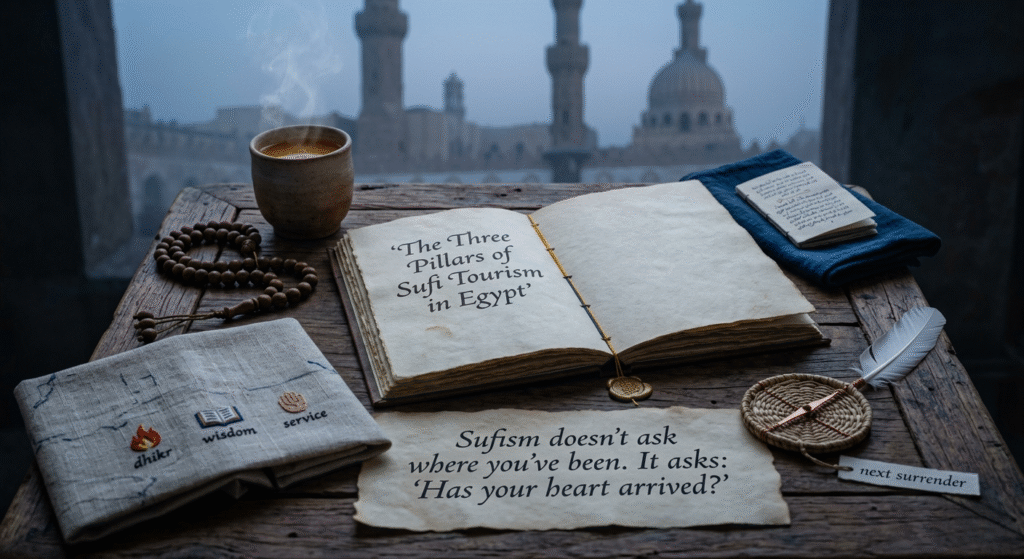
We will discuss the pillars of Sufi tourism in Egypt.
Sufi tourism in Egypt is based on three important paths to provide an unforgettable experience:
- First: Shrines: These places are called houses of blessing and include:
- The Mosque of Sayyida Zeinab (Cairo): The granddaughter of the Prophet Muhammad (peace be upon him); the greatest center of spirituality for Muslims.
- The Mosque of Sayyid al-Badawi (Tanta): He was one of the descendants of the Prophet (peace be upon him) who lived in Egypt and is considered one of the great and righteous Muslim scholars of his time. He is the founder of the Ahmadiyya Sufi order in Egypt, and a large celebration called the Mawlid of Sayyid al-Badawi is held annually in Egypt on the anniversary of his birth.
- Al-Hussein Mosque (Cairo): He is the grandson of the Prophet Muhammad (peace be upon him), who was martyred at the Battle of Karbala and buried in Egypt. He holds a very high position among Muslims, due to the high status of his grandfather, the Messenger of God (peace be upon him), who gave him glad tidings that he would be the master of the youth of Paradise. He is the brother of Lady Zaynab (may God be pleased with them both). His shrine and mosque are considered highly sacred sites, as they emanate blessings and divine manifestations.
- Abu al-Abbas al-Mursi Mosque (Alexandria): He was one of the great Muslim scholars of his time and a student of Abu al-Hasan al-Shadhili. He played a major role in spreading the Islamic faith in Egypt and settled in Alexandria, where he was buried. He has a large mosque in Alexandria containing his holy shrine, and a number of his students are buried around it.
- Secondly: Remembrance Gatherings: These are a collection of gatherings and circles held to remember God and the Prophet Muhammad (peace and blessings be upon him), including:
- Weekly Remembrance Gatherings: These are held every Thursday in the mosques of the Prophet’s family after the evening prayer, consisting of sessions for praise or Quran recitation.
- mawald and celebrations: These are a collection of large religious gatherings celebrated by Muslims in Egypt, such as the Mawlid of Sayyida Zaynab, the Mawlid of Sayyid al-Husayn, the Mawlid of Sayyid al-Badawi, and others. These gatherings are filled with warmth, spirituality, and spiritual manifestation, and feature recitations of praise for the Prophet, religious sermons by scholars, and the serving of food and sweets.
- Third: Sufi orders: These are a group of religious groups belonging to a group of scholars who have a noble lineage and a connection to our master Muhammad (peace and blessings be upon him) and their sons and students who receive the Sharia sciences from them. These orders are very widespread in Egypt, and they all complement each other under the banner of the Holy Qur’an and the Sunnah and guidance of our master Muhammad (peace and blessings be upon him). Among them are (the Shadhiliya, the Siddiqiyya, the Idrisiyya, the Marghaniyya, the Ahmadiyya, the Al Ja’fariyah, and Al Rifa’iyah).
These pillars form the spiritual architecture of Sufi tourism in Egypt.
3. Top 5 Sacred Sites for Sufi Tourism in Egypt (2026 Guide).
We will discuss the top five holy sites to visit during your Sufi journey in Egypt:
- First: Sayyida Zeinab Mosque – The Spiritual Heart of Cairo.
- One of the most famous and largest mosques of the Ahl al-Bayt (the Prophet’s family) in Egypt, it houses the shrine and burial place of Sayyida Zeinab (may God be pleased with her), the granddaughter of the Prophet Muhammad (peace and blessings be upon him). Located in the Sayyida Zeinab district, it is distinguished by its ancient Islamic design. The mosque annually hosts the Mawlid (birthday celebration) of Sayyida Zeinab, a major religious event attended by thousands. It is considered one of the most important Sufi and religious sites. The mosque consists of seven arcades parallel to the qibla (direction of prayer), surrounding a square courtyard covered by a dome. It is distinguished by its towering minaret and Islamic inscriptions. A large annual celebration called the Mawlid of Sayyida Zeinab takes place at the end of the month of Rajab each year. During this Mawlid, you can enjoy a truly magnificent spiritual atmosphere, as the mosque courtyard is filled with tents, the voices of singers resonate with praises, and food and drinks are distributed to visitors.
- Second: Sayyidna Hussein Mosque – The Spiritual Beacon of Cairo.
- This mosque was built in 1154 AD and is considered one of the most important mosques of the Ahl al-Bayt (the Prophet’s family) in Egypt. It houses a shrine containing the revered head of Sayyidna al-Husayn and is located near Khan al-Khalili and Al-Azhar Mosque. The mosque hosts major annual celebrations called the Mawlid of al-Husayn, which demonstrate the Egyptians’ devotion to the Ahl al-Bayt and include traditional and spiritual practices. The mosque has three white marble doors overlooking Khan al-Khalili and another door near the dome known as the Green Door. The Mawlid of Sayyidna al-Husayn is one of the largest Sufi and spiritual celebrations in Egypt, attracting thousands of visitors from various governorates. The celebrations include gatherings for remembrance (dhikr), praise of the Ahl al-Bayt, distribution of food and sweets, and decoration of the area surrounding the mosque.
- Third: The Mosque of Sayyid al-Badawi – Tanta’s Religious Beacon
- One of Egypt’s most famous historical mosques and a center for the Ahmadiyya Sufi order, it houses the tomb of Sidi Ahmed al-Badawi, also known as “Sheikh al-Arab” or “al-Sutuhi.” Founded in the 13th century around the shrine of Sidi Ahmed al-Badawi, one of the four pillars of Sufism, this mosque boasts unique and magnificent Islamic architecture. It features an open courtyard, a massive copper enclosure within the shrine, domes, and towering minarets. It attracts thousands of visitors annually, and the Mawlid (birthday celebration) of Sidi al-Badawi is one of the largest Sufi festivals in Egypt, held annually in October. Located in the heart of Tanta, in the Gharbia Governorate, it is one of the largest and most famous mosques in the Nile Delta.
- Fourth: Al-Ghouri Agency – The Cultural Gateway to Islamic Cairo
- It is named after Qansuh al-Ghuri and is one of the most important and beautiful Mamluk architectural monuments in Cairo. It was built by Sultan al-Ashraf Qansuh al-Ghuri in 1504 AD, at the end of the Mamluk era. Located in the Al-Azhar and Al-Ghuriya district, it was once a commercial center and residence for merchants and immigrants to Egypt at that time. Today, it is distinguished as a center for artistic and cultural creativity affiliated with the Ministry of Culture, and is called the “Al-Ghuri Agency for Heritage Arts Center.” It hosts cultural and artistic events, including performances by the Tanoura Heritage Troupe. Its design makes it an open-air museum of mashrabiya art, featuring 29 exquisite wooden mashrabiyas. Each mashrabiya consists of a rectangular open courtyard with a marble fountain at its center, and it comprises four floors.
- Fifth: The Mosque of Abu al-Abbas al-Mursi – The Religious Lighthouse of Alexandria.
- This mosque is located in the Bahri district of Alexandria Governorate and is one of the most famous and largest mosques in the governorate and the largest shrine of the righteous saints. It is surrounded by the shrines of his students such as Al-Busiri, Yaqut Al-Arsh, Al-Mawazini and Al-Wasiti. As for its design, it is considered an Andalusian architectural masterpiece designed by the Italian Mario Rossi in 1943. The mosque was built around the shrine of the Sufi saint (Shihab Al-Din Ahmad Ibn Hassan Ibn Ali Al-Khazraji Al-Ansari Al-Mursi), nicknamed Sidi Abu Al-Abbas Al-Mursi, who lived and died in Alexandria. It is considered an important spiritual center visited by thousands.
- This mosque is located in the Bahri district of Alexandria Governorate and is one of the most famous and largest mosques in the governorate and the largest shrine of the righteous saints. It is surrounded by the shrines of his students such as Al-Busiri, Yaqut Al-Arsh, Al-Mawazini and Al-Wasiti. As for its design, it is considered an Andalusian architectural masterpiece designed by the Italian Mario Rossi in 1943. The mosque was built around the shrine of the Sufi saint (Shihab Al-Din Ahmad Ibn Hassan Ibn Ali Al-Khazraji Al-Ansari Al-Mursi), nicknamed Sidi Abu Al-Abbas Al-Mursi, who lived and died in Alexandria. It is considered an important spiritual center visited by thousands.
4. A Perfect 4-Day Itinerary: Your Sufi Tourism in Egypt 2026 Blueprint.
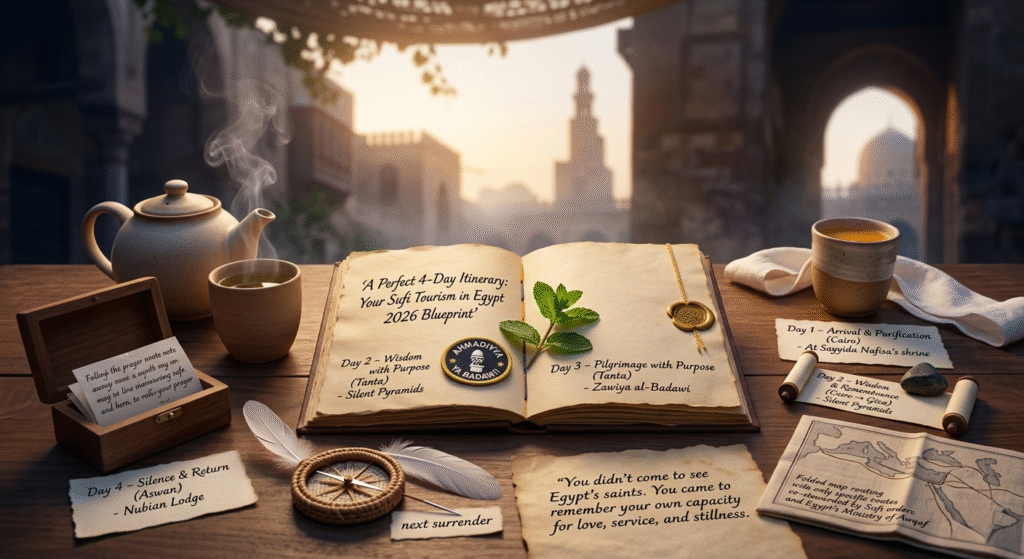
Here’s a perfect 4-day itinerary for Sufi tourism in Egypt:
- Day 1: Cairo
- This morning, we’ll visit the Sayyidna Hussein Mosque, pray there, and visit the shrine of Sayyidna Hussein. Afterwards, we’ll take a stroll through Khan el-Khalili, located nearby, to enjoy the traditional crafts until midday. Then, we’ll have lunch at Naguib Mahfouz Restaurant. In the afternoon, we’ll visit the Sayyida Zeinab Mosque, pray there, admire its unique Islamic architecture, and visit the shrine of Sayyida Zeinab. Following that, we’ll visit the Sayyida Nafisa Mosque, the granddaughter of the Prophet Muhammad (peace be upon him), and pray the Maghrib and Isha prayers there. We’ll also visit her shrine and seek blessings. Afterwards, we can visit a cultural site like the Qubbat al-Ghouri to attend a Sufi gathering or enjoy a stroll along Al-Muizz Street.
- Day 2: Cairo
- We will spend this wonderful day between the study area and East Cairo. In the morning, we will visit the Mosque of Sidi Saleh al-Jaafari and his shrine. He was one of the leading scholars of Al-Azhar in his time, and many scholars studied under him. Afterwards, we will visit the Mosque of Sayyida Aisha, a descendant of the Prophet Muhammad (peace be upon him), and perform the noon prayer there, visiting her shrine and offering supplications. After lunch at a local restaurant in the Sayyida Aisha area, we will visit the mosque and shrine of Sidi Abdullah ibn Jamra and the shrine of Sidi Ibn Ata Allah al-Iskandari. They were two eminent scholars of their time, highly esteemed and of noble lineage to the Prophet Muhammad (peace be upon him). One of Sidi Ibn Ata Allah al-Iskandari’s most prominent religious contributions, which Muslims still cherish today, is his book “Al-Hikam al-Ata’iyya” (The Aphorisms of Ibn Ata Allah). In the evening, we will return to the hotel for dinner and record our day’s events.
- Day Three: Alexandria
- This morning we begin by heading to the train station and taking the train to Alexandria. The journey takes two hours. Upon arrival, we can visit the Abu al-Abbas al-Mursi Mosque, one of the most important Sufi mosques in Alexandria and the center of the Mursi Shadhili order. We will admire the mosque’s exquisite Islamic architecture, pray there, and visit the shrine of Sidi Abu al-Abbas al-Mursi and his disciples, offering prayers in this blessed sanctuary until noon. Afterwards, we will have lunch at a restaurant overlooking the sea, where we can enjoy a meal of fresh seafood. Following lunch, we will take a charming stroll along the Alexandria Corniche. In the evening, we will visit the Qaid Ibrahim Mosque, a venerable Sufi mosque that combines simplicity and spirituality, its tranquil atmosphere perfect for prayer and Quran recitation. At the end of the day, we will return to Cairo by train and then go back to the hotel for dinner.
- Day Four: The Delta and the Spiritual Conclusion
- We begin our day in the morning by heading to the train station and traveling to the city of Tanta. This journey takes two hours. Upon arrival, we can visit the Sidi Ahmed Al-Badawi Mosque, one of the most important Sufi mosques and shrines in the city of Tanta. He was one of the great scholars of his time, in addition to his noble lineage that extends back to our master, the Messenger of God (peace and blessings be upon him). We can spend a magical time there, as the mosque is filled with an atmosphere of tranquility and beautiful spirituality. We will pray in it, visit the holy shrine, and spend the whole day there to learn about the life of Sidi Ahmed Al-Badawi, his knowledge, and his students. We will have lunch at one of the local restaurants surrounding his mosque. In the evening, we will go to the train station to return to the city of Cairo, where our irreplaceable spiritual journey will end.
- We begin our day in the morning by heading to the train station and traveling to the city of Tanta. This journey takes two hours. Upon arrival, we can visit the Sidi Ahmed Al-Badawi Mosque, one of the most important Sufi mosques and shrines in the city of Tanta. He was one of the great scholars of his time, in addition to his noble lineage that extends back to our master, the Messenger of God (peace and blessings be upon him). We can spend a magical time there, as the mosque is filled with an atmosphere of tranquility and beautiful spirituality. We will pray in it, visit the holy shrine, and spend the whole day there to learn about the life of Sidi Ahmed Al-Badawi, his knowledge, and his students. We will have lunch at one of the local restaurants surrounding his mosque. In the evening, we will go to the train station to return to the city of Cairo, where our irreplaceable spiritual journey will end.
This itinerary balances devotion, education, and reflection—the essence of Sufi tourism in Egypt.
5. Ethical Guidelines: Travel with Reverence.
Ethical Guidelines: Travel with Reverence
Sufi tourism in Egypt demands deep respect:
- First: Clothing: Dress modestly, cover shoulders/knees; women wear a headscarf in all religious sites
- Second: The official protocol for the visit: Silence is Sacred. Speak in whispers; never shout or laugh loudly in shrines
- Third: Photography: Never photograph during dhikr. Ask permission before photographing individuals
- Fourth:Donations: Small offerings (50–100 EGP) at shrines support upkeep
“The visitor’s heart matters more than their passport.”
— Fatima Hassan, Sayyida Zeinab Volunteer, 2025
This mindfulness is essential to Sufi tourism in Egypt.
6. When to Go: The 2026 Spiritual Calendar.
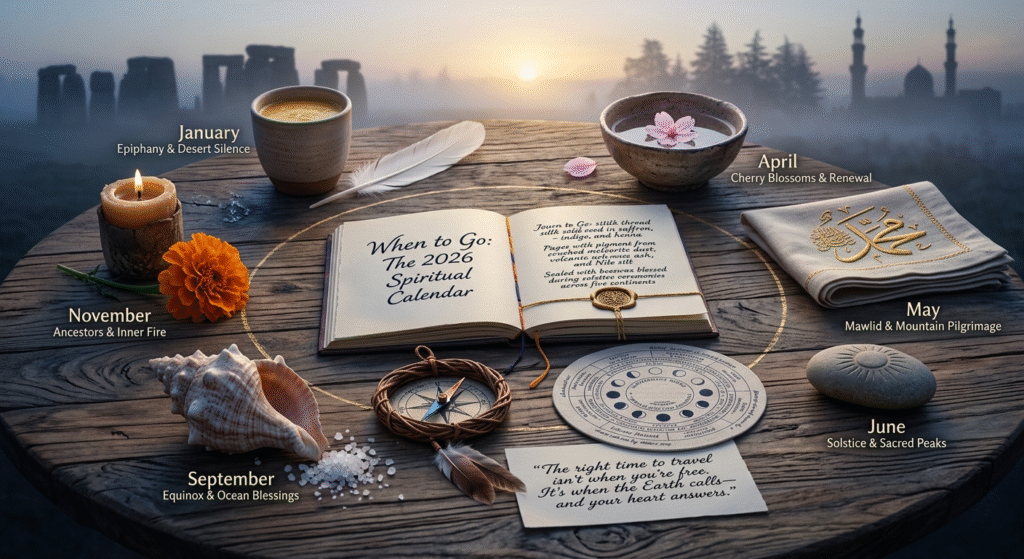
| Time | Experience | Considerations |
| October 15–22 | Tanta Mulid | Crowded but spiritually electric; book early |
| Ramadan 2026 (Feb 18–March 16) | Nightly dhikr, tarawih prayers | Eat/drink discreetly during daylight; some sites close early |
| Mawlid al-Nabi (Sept 2026) | Prophet’s birthday celebrations | Processions at Al-Hussein Mosque |
| Avoid: Fridays at noon | Jumu’ah prayer | Most mosques are closed to non-worshippers |
Timing your visit aligns with the rhythms of Sufi tourism in Egypt.
7. Practical Tips for Visitors (2026).
- Language: Learn “As-salamu alaykum” (Peace be upon you), “Shukran” (Thank you)
- Guides: Hire Al-Azhar-certified guides for context
- Transport:
- Cairo Metro: Women-only cars (first car, pink sign)
- Uber: Use “Uber Women” for solo female travelers
- Safety: Low crime; Tourist Police (dial 126) at major sites
Preparation ensures a smooth Sufi tourism in Egypt journey.
8. Common Misconceptions Debunked.
Incorrect: “Sufism is entertainment.”
→ Correct: Dhikr is worship—not performance. Tanoura shows are cultural adaptations.
Incorrect: “You must be Muslim to visit.”
→ Correct: Non-Muslims are welcome with respectful conduct outside prayer times.
Clarity like this prevents offense in Sufi tourism in Egypt.
9. The Future of Sufi Tourism in Egypt (2026–2027).
Digital Ziyara Platform: Virtual tours of shrines with scholar commentary- Sufi Heritage Trail: Ministry of Tourism route linking 10 key sites
- Women’s Dhikr Circles: Expanded access for female spiritual seekers
- Academic Partnerships: Al-Azhar is offering short courses on Sufi ethics for travelers
Egypt is nurturing Sufi tourism in Egypt as a bridge, not a commodity.
10. Final Reflection: The Journey Inward.
Sufi tourism in Egypt is not about collecting sites—it’s about shedding layers. In the echo of dhikr, the scent of oud, and the silence between prayers, you may find what no monument can give: a moment of pure presence.
So go. But go humbly. Go quietly. And let Sufi tourism in Egypt—not as a checklist, but as a whisper to the heart—remind you that the greatest journey is the one inward.
Trusted Resources (2026).
- Al-Azhar portal : https://www.azhar.eg
- Ministry of Awqaf : The official platform of the Ministry of Awqaf
- Egypt Tourism Authority : https://www.experienceegypt.eg/en/attraction/17/spiritual-egypt
Always verify prayer times and event dates before visiting.
Follow us :
Articles that might interest you :
Solo Travel for Arab Women Egypt: Your Safe, Free & Authentic Guide (2026).