Tbilisi and Batumi, Georgia 2026: Your Ultimate Travel Guide to the Caucasus Crossroads—Where Ancient Wine, Soviet Echoes, and Black Sea Glamour Unite.
Posted in :

Introduction: Georgia’s Dual Soul, Reimagined for the Modern Traveler.
Tbilisi and Batumi are two Georgian cities that will be unique and dynamic in 2026. These cities mirror what is old and new, in rough and unrefined, but they are unified, friendly, and powerful. Tbilisi is a maze of little streets which have Persian caravanserais against Soviet concrete buildings with Art Nouveau balconies covered in wisteria. In Batumi, there are also beaches with palm trees along the Black Sea and new architecture with ancient Ottoman mosques. In this case, the two cityscapes of Georgia attest that the nation is at its 2000-year-old glorious historical past and 21st-century ambition.
The steady progress of the country on its way to the EU accession and its increasing input in eco-friendly tourism will make Tbilisi and Batumi welcome tourists in 2026. They will take visitors through activities that are sincere, ethical, and highly human. The country is currently a popular tourist spot, not yet exploited by mass tourism. Georgia continues to appeal to adventurous travelers as it offers a UNESCO-listed wine culture and stunning views of the mountain ranges, and the tradition of festival eating that is associated with the practice of supra (feast).
Tbilisi and Batumi, Georgia 2026 guide gives you the final word, trained insight about how to experience this Caucasus-gem. Powered by 2025-2026 data by Georgian National Tourism Administration UNESCO, indigenous vintners, and community homestays, it sees past the regularised itineraries to explain to hidden courtyards, family wineries, ethical tour operators, and transport innovation that revive the past of Georgia and the future unfolding of Georgia.
This guide will make your travel in Tbilisi and Batumi, Georgia 2026, exciting, respectful, and memorable, whether you are a wine fan, a history fan, a beach fan, or a digital nomad.
1. Why Tbilisi and Batumi, Georgia 2026 Is Europe’s Best-Kept Secret—No Longer.
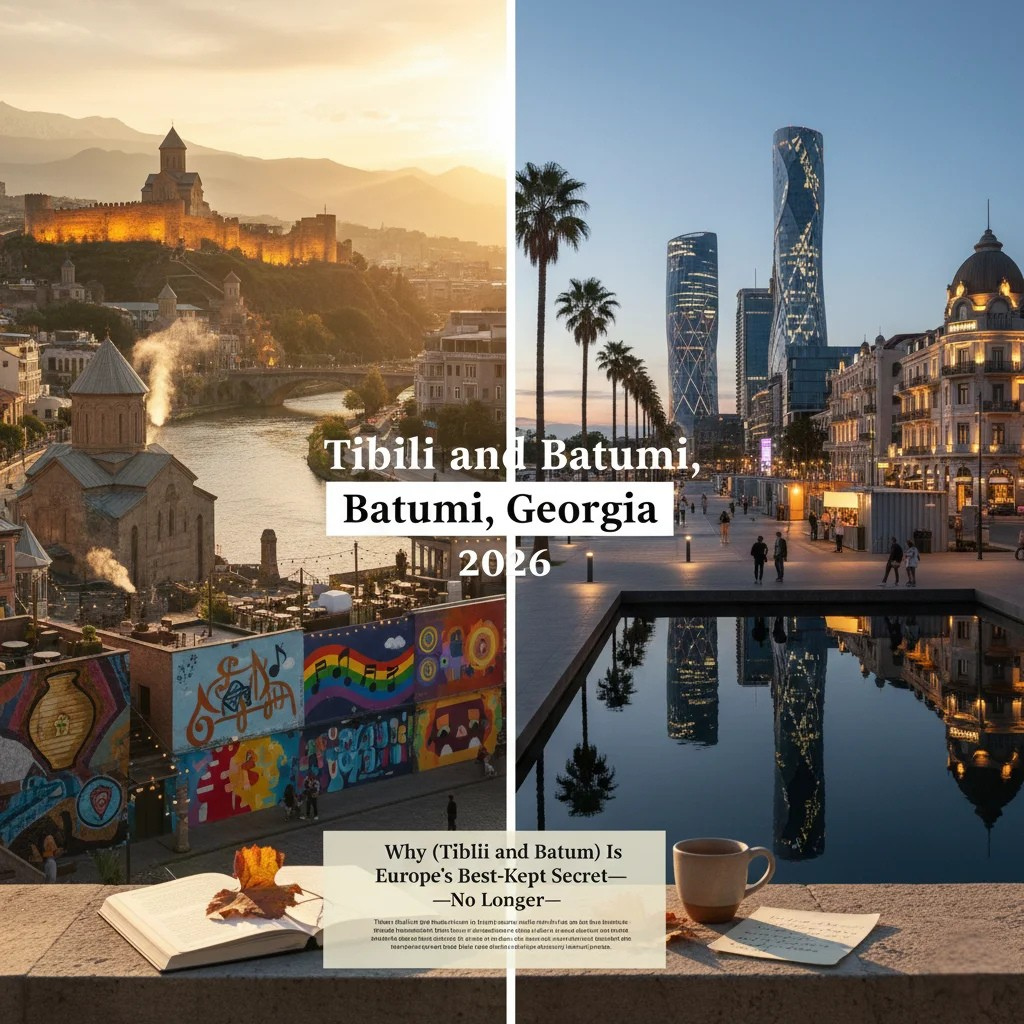
We will discuss the reasons why Tbilisi and Batumi are now among the best destinations in Europe:
- Firstly, Georgia is currently experiencing a surge in tourism. It offers visa-free travel for citizens of over 95 countries and facilitates easy access thanks to direct flights to and from Europe and the Gulf region. Furthermore, it boasts a range of authentic and enjoyable experiences, particularly in these two cities, all at reasonable prices. This is a unique opportunity to experience Europe at affordable prices. As a result, by 2025, Georgia had welcomed over 9 million tourists, and many of its stunning areas remain unexplored, open to all except during the summer season.
- Secondly, the Georgian government recently launched a sustainable and smart tourism strategy. This initiative includes the following:
- 70% of tourism funding is allocated to support family-run guesthouses and grapes vineyards.
- The government launched the Georgia Travel app, which provides comprehensive information about the country, including transportation and city guides enhanced with augmented reality technology (https://georgia.travel/), in conjunction with the Georgian e-Visa platform (https://www.evisa.gov.ge/GeoVisa/). In addition, there is another government-approved app covering all aspects of tourism in the country (https://visitgeorgia.ge/).
- The government launched the Tbilisi-Batumi high-speed train and is working on expanding the capital’s international airport.
- The government is also working on preserving cultural heritage by restoring the Sioni Cathedral and the Old Town in Batumi.
Georgia doesn’t sell destinations—we share our home.”
— Giorgi Tsetsadze, Head of International Promotion, National Tourism Administration, 2025
This intentional approach makes Tbilisi and Batumi, Georgia 2026 a model of inclusive, heartfelt travel.
2. The Two Cities, One Nation: Contrasts That Complement.

The cities of Tbilisi and Batumi are contrasting yet complementary for several reasons:
- Firstly, Tbilisi: This ancient city, often called the spiritual capital, boasts a rich historical and spiritual atmosphere. Located in the Mtkvari River valley and surrounded by mountains on three sides, its most charming feature is that all its tourist areas are situated along the riverbanks, lending the city an authentic charm. Among its most prominent landmarks are wooden balconies, sulfur baths, elegant courtyards, Narikala Fortress, and the Dry Bridge Market, which houses artifacts from the Soviet era, including old maps and cameras.
- Second: Batumi: It is a modern and contemporary city located on the Black Sea coast at the foot of the Lesser Caucasus Mountains. Its most prominent features include a charming promenade lined with palm trees, fountains, and magnificent sculptures, known as the Batumi Corniche. It also has the Alphabet Tower, which displays Georgian writing. This is a national site that the people of the country are proud of. In addition, there is the old city of Batumi, which contains Ottoman mosques, nineteenth-century villas, and cafes overlooking the sea.
Insight: The magic of Tbilisi and Batumi, Georgia 2026 lies in experiencing both—Tbilisi’s soulful beauty and Batumi’s coastal Fun.
3. Must-Experience Cultural Immersion (2026).

We will explore a selection of unmissable cultural experiences in both cities:
- First: The sulfur baths of Abanotubani: These baths are wonderful for those interested in therapeutic tourism. Built in the Persian style in the 18th century, they contain natural sulfur springs. The best places to visit are:
- The Cerili Abano Baths: These feature private rooms of historical value, lined with marble.
- The Orbeliani Baths: Designed in the Art Nouveau style.
- Reservations: It is essential to make a reservation in advance and bring your swimwear. It is best to visit on a day other than Sunday, as it is extremely crowded.
- Second: Wine tasting experience in Kakheti: Georgia has been famous for its wine industry for 8,000 years, a tradition that continues to evolve. While still using earthenware pots, the winemaking process is a UNESCO World Heritage Site. One of the best places to experience this is the Marani Winery in Sighnagi, a family-run establishment where you can witness the traditional earthenware winemaking process and even attend a Supra feast.
- Third: Visit Batumi Botanical Garden: This open-air museum was founded in 1880 by the Russian botanist Andrei Krasnov. Reasons to visit include:
- It boasts over 5,000 plant species from 10 different climate zones.
- It features a cable car that traverses subtropical valleys.
- It offers breathtaking panoramic views of the Black Sea.
These experiences connect you to Georgia’s living heritage—not just its aesthetics.
4. Beyond the Icons: Hidden Gems Only Locals Know.

We will explore a selection of wonderful hidden gems that shouldn’t be missed in both cities:
- First: Fabrica Tbilisi: Formerly a Soviet garment factory, this place has been transformed into a wonderful urban center, resembling an oasis. Among the main reasons to visit are:
- A collection of cafes where musical gatherings take place.
- Trade galleries showcase artwork and designs.
- You can ascend to the rooftop, which offers a magnificent panoramic view of the Holy Trinity Cathedral.
- The best time to visit is in the evening, when you can mingle and connect with locals after work.
- Second: Batumi Green Bazaar: This urban market offers a vibrant atmosphere of local life. Here you’ll find spices, churchkhela (a delicious grape juice), and matsune (yogurt). The main reasons to visit are:
- The opportunity to interact with local vendors; they are friendly and make you feel right at home.
- Fresh and inexpensive food is available, after which you can stroll along the main street.
- Third: Tbilisi Obelisks: These ancient obelisks, standing 30 meters tall on Kessaria Hill, represent a part of Georgian history and are known as the “Records of Georgia.” Among the main reasons to visit them are:
- The breathtaking panoramic view of the city they offer. They are less popular than Narikala.
- Fourth: Tbilisi National Botanical Garden: Located behind Narikala Fortress in the Old Town, this garden was established in the 19th century. It features a natural waterfall, thousands of plant species, and vast green spaces perfect for strolling. It is open daily from 9:00 AM to 8:00 PM.
- Fifth: Batumi Square: This charming square, designed in the Venetian style, features a tower with a large clock and beautiful fountains. Among the main reasons to visit it are:
- The open-air concerts held here.
- In the evening, a dazzling light show takes place. At this time, you can relax in the charming cafes or shop in one of the malls surrounding the square. There are also hotels nearby.
These treasures reveal the depth beneath the surface of Tbilisi and Batumi, Georgia 2026.
5. A Perfect 6-Day Itinerary: Your Tbilisi and Batumi, Georgia 2026 Blueprint.

Here’s a perfect 6-day itinerary to Tbilisi and Batumi:
- Day 1: We’ll spend time in the Old City, taking a wonderful walking tour followed by a visit to the sulfur baths and dinner at Shafi Lomi Restaurant.
- Day 2: We’ll visit Narikala Fortress and tour it, then head to the Dry Bridge Market for some shopping. In the evening, we’ll enjoy a delightful evening at Fabrika.
- Day 3: We’ll visit the Kakheti wine country, tour the wineries, and visit the Marani Winery in Sighnaghi and the Alaverdi Monastery.
- Day 4: We’ll travel to Batumi by train (5 hours) or by plane (45 minutes). Upon arrival, we’ll check into a hotel overlooking the sea.
- Day 5: We’ll explore Batumi Boulevard, the Old City, and the Botanical Garden.
- Day 6: We will visit Batumi Green Market and Piazza Square to take a wonderful tour of each, and then in the evening we will return to the Old City for a fresh seafood dinner.
Transport Tip: Use Marshrutka (minibus) for budget travel; Georgian Railways for comfort (railway.ge).
This itinerary balances culture, nature, and relaxation—the essence of Tbilisi and Batumi, Georgia 2026.
6. Where to Stay: Best Neighborhoods & Hotels (2026)

| City | Neighborhood | Best For | Top Picks |
| Tbilisi | Old Town | History, charm | Rooms Hotel Tbilisi, Tiflis Hotel |
| Tbilisi | Vera | Local vibe, affordability | Hotel Astoria, Stamba Hotel |
| Batumi | Old Town | Culture, sea views | Radisson Blu, Hotel Intourist |
| Batumi | Boulevard | Luxury, convenience | Sheraton Batumi, Pullman Batumi |
Tip: Choose family guesthouses in Tbilisi’s Sololaki or boutique hotels in Batumi’s Old Town for authenticity.
Your base shapes your Tbilisi and Batumi, Georgia 2026 experience—choose with intention.
7. Culinary Georgia: From Khachapuri to Churchkhela.

- Must-Try Dishes:
- Khachapuri is bread filled with cheese (Adjaran refers to boat bread with an egg).
- Khinkali is a soup dumpling. It is eaten by the knot.
- Churchkhela is grape juice combined with nuts of the snack type known as the Georgian Snickers.
- Tbilisuri-Tbilisi: new style fried bread served with cheese and egg.
- Top Ethical Spots:
- Barbarestan (Tbilisi): the restaurant revives recipes of the nineteenth century.
- Old Batumi (Batumi): good Black Sea view, along with fresh cooking of the Sea.
Food is hospitality, not dealing only in Tbilisi and Batumi, Georgia 2026.
8. Sustainable Travel in the Caucasus.
- Transport:
- Trains: Scenic, cheap, green.
- Marshrutkas: Shared minivans are the most affordable way of travel.
- Walk: The two cities are small and can be walked by people.
- Plastic-Free: Refillable bottle-Carry with you-Rentable water is refillable in urban areas.
- Support Local: Purchase wine at wineries and engage certified local guides.
Sustainability ensures Tbilisi and Batumi, Georgia 2026 remains vibrant for generations.
9. When to Visit Tbilisi and Batumi, Georgia 2026.
| Season | Pros | Cons |
| May–June | Mild temps (20–25°C), blooming mountains, wine season | Slightly higher prices |
| September–October | Harvest season, golden landscapes, fewer crowds | Occasional rain |
| July–August | Warm sea (24–26°C), Batumi festivals | Hot in Tbilisi (35°C+), crowded |
| Avoid: November–March | Snowy mountains, quiet cities, lower prices | Cold (0–5°C), some closures |
Best Window: Late May or early October—ideal weather, cultural energy, manageable crowds.
Timing your trip honors Georgia’s natural and cultural rhythms.
10. Practical Tips for Travelers (2026).
- Visa-Free Travel to 95+ Countries (EU, US, UK, Gulf), 365-Day Stay
- Currency. Georgian Lari (GEL), in urban areas, card payment, and in rural areas, cash.
- Language. Georgian; the English level is gradually getting better. Therefore, it is necessary to hire a certified guide who is proficient in English.
- Safety: Very safe, low crime, Tourist Police are present at most large sites.
Preparation ensures a smooth Tbilisi and Batumi, Georgia 2026 journey.
11. Common Mistakes to Avoid.
- Wrong: Skipping the toast ritual → right: Never refuse chacha (grape brandy) at a supra
- Wrong: Drinking tap water in rural areas → right: Stick to bottled water outside cities
- Wrong: Visiting sulfur baths unprepared → right: Book ahead, bring a towel.
- Wrong: Overlooking Kakheti → right: The soul of Georgia is in its vineyards
Respect and awareness deepen your Tbilisi and Batumi, Georgia 2026 connection.
12. Final Reflection: The Land That Toasts to You.
Tbilisi and Batumi, Georgia 2026 are not just destinations—they are invitations. An invitation to share bread, to drink wine from a horn, to dance perkhuli until dawn, and to be called “family” by strangers who mean it.
So go. But go with an open heart. Go with curiosity. And let Tbilisi and Batumi, Georgia 2026—not as a checklist, but as a dialogue between ancient land and generous people—remind you that the best journeys are those where you leave not just with memories, but with new kin.
Trusted Resources (2026).
- National Tourism Administration:
https://www.visitgeorgia.ge - UNESCO – Ancient and Primeval Beech Forests (includes Georgian sites):
https://whc.unesco.org - Georgian Railways:
https://www.railway.ge - Wine Tourism Georgia – Certified Wineries:
https://www.wine.gov.ge - Tbilisi City Hall – Cultural Events:
https://georgia.to/en/entertainment/cultural-festivals/
Always verify opening hours and transport schedules before travel.