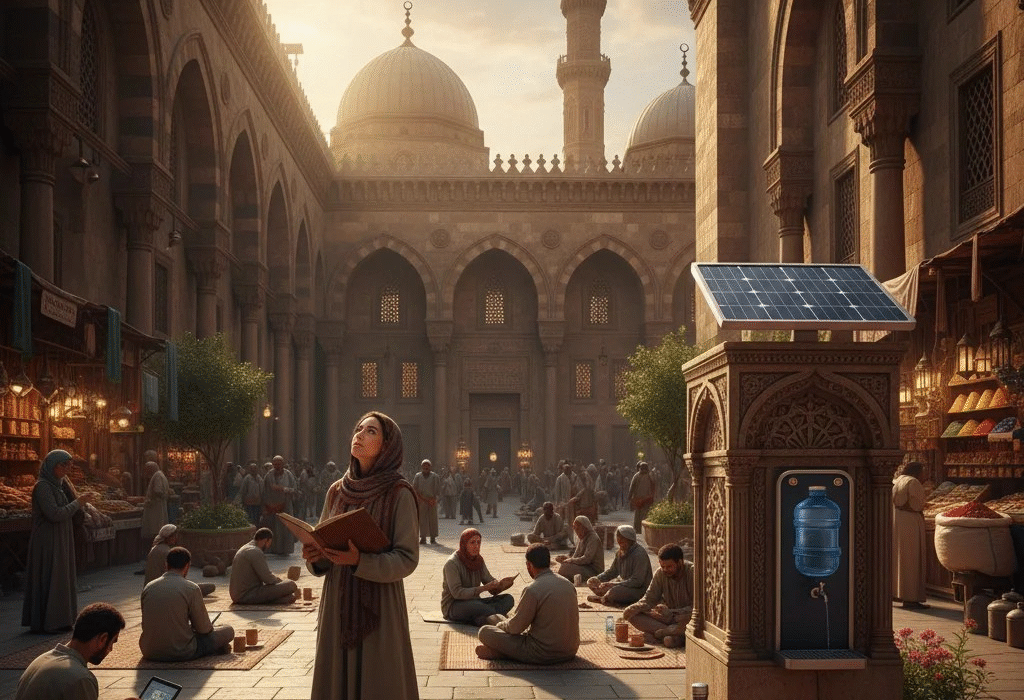
Discover the heart of Islamic Cairo guide 2026: from the courtyards of Al-Azhar to the grandeur of Sultan Hassan’s palace and the markets of Khan El-Khalili .
Posted in :

Introduction: Walk Where Caliphs Prayed and Artisans Crafted.
In this article, we will discuss Cairo and its Islamic character. It is one of the oldest cities, boasting a rich and abundant Islamic history evident in numerous areas and landmarks that still preserve their original architectural heritage. It is an ideal Islamic destination for those wishing to learn more about Islam. Its Islamic quarters possess a charm that rivals the most sophisticated urban areas in the world. It is also home to Al-Azhar, a prominent center and beacon of Islamic studies, attracting a vast number of Muslims from around the globe, including students and researchers.
Islamic Cairo, with all its facets, especially with the government’s expanding efforts in heritage preservation and restoration, offers unique opportunities and an unforgettable tourist experience in 2026 for those seeking immersive cultural experiences. Its neighborhoods continue to pulsate with life, surrounded by ancient and sacred landmarks that welcome all. However, if you wish to explore these quarters, you will need careful planning and a guide who understands Islamic culture and its intricacies.
This Islamic Cairo Guide 2026 is your ideal guide because it is based on insights from Al-Azhar scholars, local craftsmen, and the Egyptian Ministry of Tourism. It offers you a comprehensive journey that respects heritage and allows you to immerse yourself in one of the most important cities of Islamic civilization around the world. From the sense of calm and tranquility that fills Al-Azhar Mosque to the vibrancy of Khan Al-Khalili, this guide ensures that you will not only visit Islamic Cairo, but feel its pulse.
1. Why Islamic Cairo Matters in 2026.
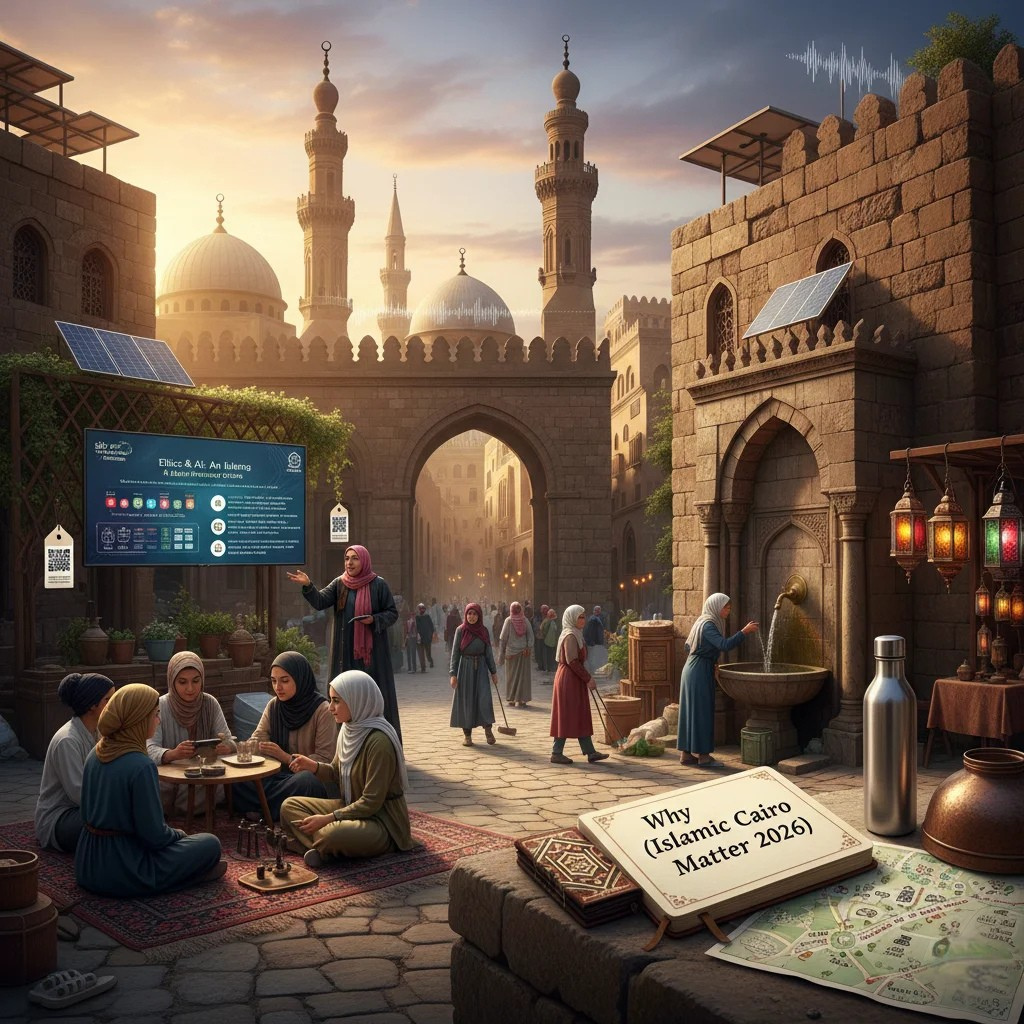
- Islamic Cairo was founded in 969 AD during the reign of the Fatimid Caliph Al-Mu’izz. This marked the beginning of its rise to become a leading center of the Islamic world, thanks to its political, intellectual, and religious centers. Its progress continued under the Mamluks in the mid-14th century, flourishing in other fields such as trade, arts, architecture, and law.
- Many important Islamic landmarks and sites are recognized by UNESCO as World Heritage Sites. Spanning 600 acres, Cairo boasts:
- More than 500 historical monuments.
- It is known as the City of a Thousand Minarets, as it contains over a thousand mosques, in addition to numerous cemeteries.
- It is home to Al-Azhar University, the oldest university in Africa, founded in 970 AD.
- The Egyptian government has undertaken a restoration and preservation project for Islamic heritage sites throughout Islamic Cairo as part of the Historic Cairo Revitalization Project, which has received support from UNESCO and the Aga Khan Trust for Culture (Historic Cairo – UNESCO World Heritage Centre) . It is repaving narrow alleys, cleaning facades and improving lighting, making it easier to walk around its neighborhoods than ever before.
This makes your visit to Islamic Cairo guide 2026 not just timely—but transformative.
2. The Three Pillars of Islamic Cairo: Architecture, Knowledge & Commerce.
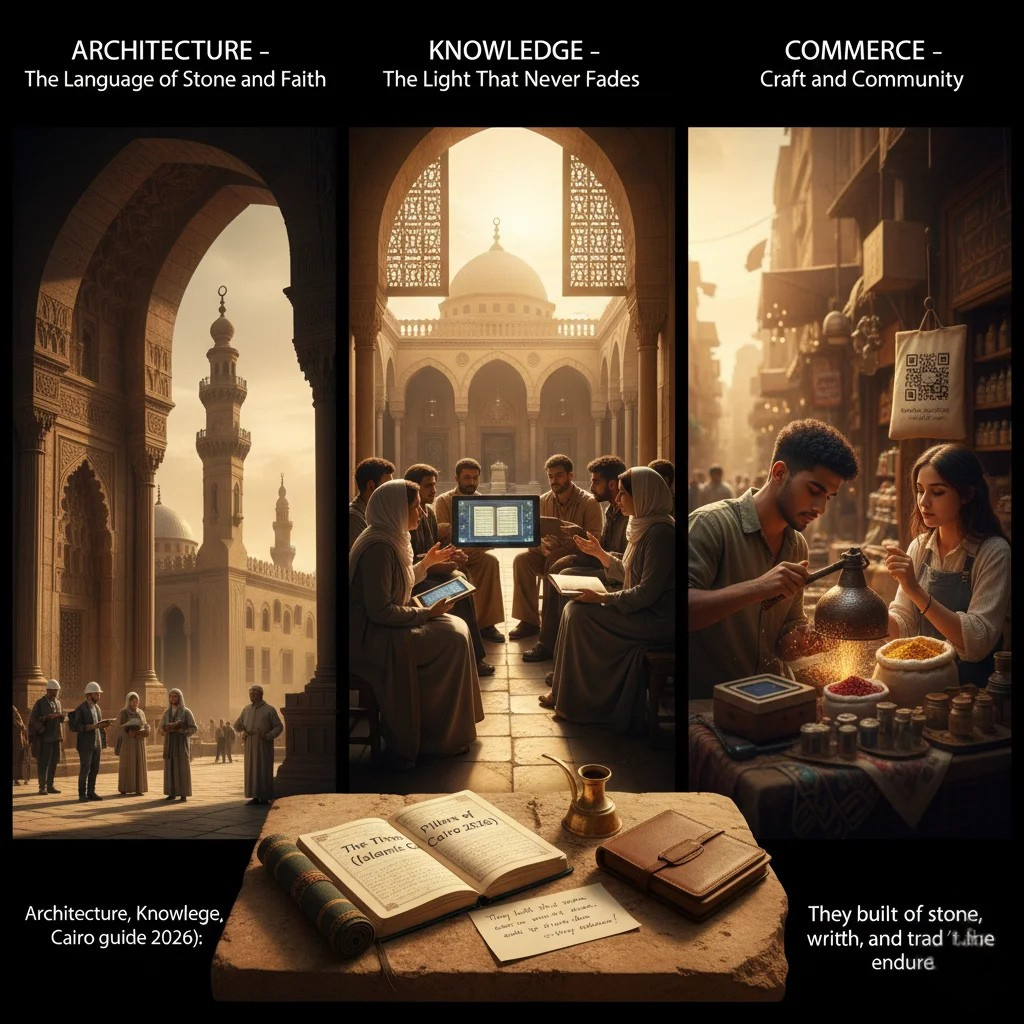
First: The Art of Architecture in Islamic Cairo
The architecture in Islamic Cairo did not rely on aesthetic form, but rather, its primary aim was to highlight the spirit of Islam. Examples of this include the arches, domes, and Arabic decorations found in:
- Al-Hakim Mosque, built in the Fatimid style (10th-12th centuries CE), consists of a strong structure with a beam-shaped arch.
- Saladin’s Citadel, built in the Ayyubid style (12th-13th centuries CE), has a strong yet simple structure.
- The Mosque of Sultan Hassan, built in the Mamluk style (13th-16th centuries CE), features exquisite stonework, two minarets, and domed tombs.
Second: Islamic Sciences and Education
Islamic Cairo was shaped to be a beacon of science and knowledge, housing institutions such as Al-Azhar Mosque and Al-Azhar University, which has more than 150,000 students from over 110 nationalities. Religious schools teach students to memorize the Holy Quran, in addition to teaching Islamic jurisprudence. This is clearly evident today in the sessions of the Al-Azhar Mosque’s Riwaq (colonnade).
Third: Trade as a Part of Community Life
Islamic Cairo has many important markets located near places of worship, such as:
- Khan al-Khalili: A market built in 1382 AD, which has since become a symbol of Egyptian crafts worldwide.
- The Coppersmiths’ Market: Home to craftsmen who still produce brass.
- Now, near Khan al-Khalili, there are markets for other commercial activities and upscale tourist cafes, such as El Fishawy Cafe.
These layers—stone, scripture, and street—form the triad of Islamic Cairo guide 2026.
3. Must-Visit Landmarks in Islamic Cairo (2026 Edition).
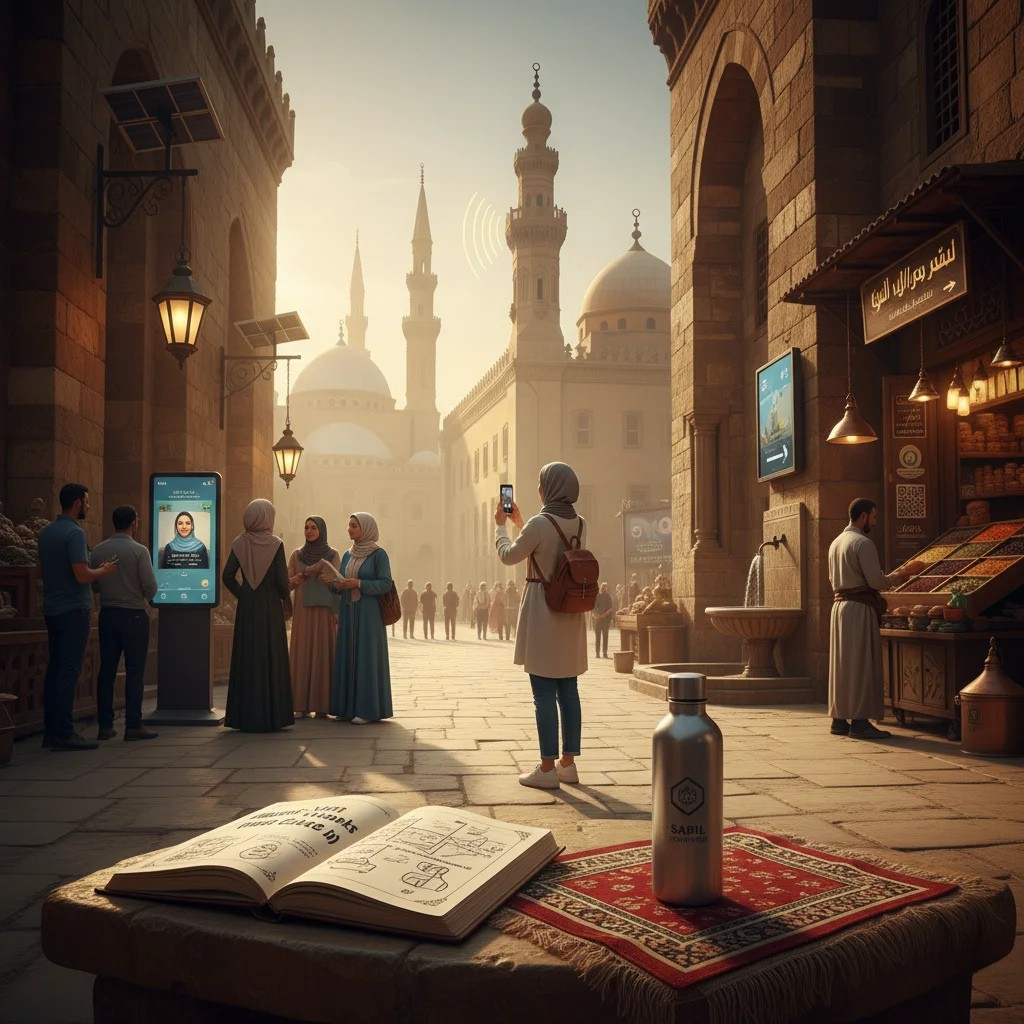
First: Al-Azhar Mosque and University
- Al-Azhar is not merely a mosque and university, but a religious and scholarly center dating back to the Fatimid era (since 970 AD).
- Al-Azhar Mosque is a magnificent example of Islamic architecture and remains a beacon of Islamic knowledge and faith, attracting Muslims from all over the world.
- Al-Azhar is distinguished by its beautiful, tranquil courtyard, imbued with a spiritual atmosphere.
- It is open to non-Muslims outside of prayer times (please refer to Al-Azhar official site ).
- Women visiting Al-Azhar Mosque must cover their hair and wear loose-fitting clothing.
- Souvenir photos may be taken in the Al-Azhar courtyard, away from the study circles and prayer halls. Respectful and quiet demeanor is advised.
Second: Sultan Hassan Mosque
- Sultan Hassan Mosque: This mosque was built during the Mamluk era, in the reign of Sultan Hassan ibn Sultan, between 1356 and 1363 AD.
It is one of the most important Islamic landmarks to visit, as it is one of the largest mosques in the world.
Its minaret reaches a height of 57 meters, and its massive columned hall resonates with every step you take.- This mosque was originally built as a combination of a mosque, a school, a shrine, and a hospital, but it is now a mosque and tourist attraction.
- Entrance fee is 200 Egyptian pounds (which also includes the upper balconies). Climb the stairs to enjoy a panoramic view of Cairo.
- It is recommended to visit early, around 8:00 AM, to avoid the crowds and the heat.
Third: Khan El-Khalili Market
- Founded in 1382 AD by Prince Jaharkas El-Khalili.
- It is a large commercial center for handicrafts. When you wander through it, you feel as if you are strolling through a museum.
- You can see handmade glass lamps, copper coffee sets decorated with Quranic inscriptions, and papyrus with Islamic geometric patterns.
- If you wish to shop there, it is advisable to have a guide, as they can determine the true price of goods. Avoid shops with fixed prices.
- One of the best places to visit is El Fishawy Café (established in 1773), where Naguib Mahfouz wrote his Cairo Trilogy.
- The best time to visit Khan el-Khalili is around 5:30 PM, when the sun’s rays filter through the alleyways and shopkeepers light their lanterns.
Fourth: Al-Muizz Street
- This 1.5 km long street is the historical heart of Islamic Cairo.
- It contains more than 60 landmarks, the most important of which are: Al-Hakim Mosque (built in 1013 AD), the Qalawun Complex, and Beit al-Suhaymi (a 17th-century Ottoman house).
- When touring it, start from the north (Bab al-Futuh) to the south (Bab Zuwayla), and this should be accompanied by a licensed tour guide to help you understand the architectural symbols.
- If you want to enjoy visiting it, this should be during the month of Ramadan to attend the evenings and night festivals.
This street is the artery of Islamic Cairo guide 2026—walk it slowly, with eyes and heart open.
4. A Perfect One-Day Itinerary: Your Islamic Cairo Guide 2026 Blueprint.
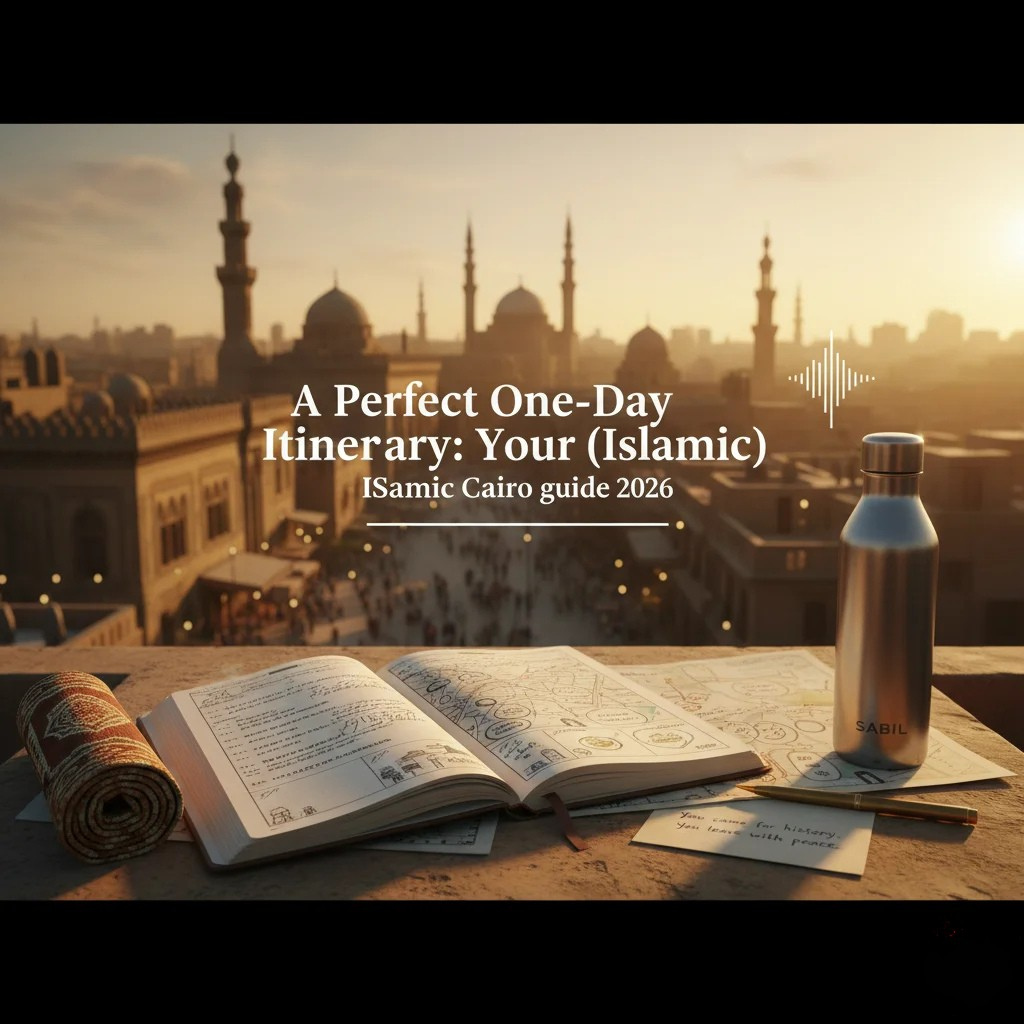
Here’s a perfect one-day itinerary for Islamic Cairo:
- First: Visit Al-Muizz Street around 7:00 AM, before the crowds and heat. The weather is wonderful. Then head to Al-Hakim Mosque and the Qalawun Complex.
- Second: Visit Al-Azhar Mosque around 9:00 AM to stroll through its courtyard and observe students studying. Remember to maintain silence due to the sanctity of the place.
- Third: Visit Sultan Hassan Mosque and Al-Rifai Mosque around 11:00 AM to admire the Islamic architecture of these two mosques.
- Fourth: Go to Naguib Mahfouz Cafe and Restaurant for lunch around 1:00 PM. They offer a menu featuring delicious Egyptian dishes such as fatta, molokhia, and kofta. Enjoy mint tea in a literary atmosphere.
- Fifth: Visit Khan El-Khalili around 3:00 PM. A stroll through the market is enchanting, allowing you to admire handcrafted goods, watch coppersmiths, buy souvenirs, and have coffee at El-Fishawy Cafe.
- Sixth: Visit the Al-Ghouri Complex around 5:30 PM, ascending to the top of the Al-Ghouri Madrasa to enjoy a panoramic view at sunset.
- Seventh: Visit the Sayyida Zeinab Mosque on Thursday evening after the Isha prayer to enjoy watching and listening to the Sufi dhikr gatherings.
- Note: The best time to visit Khan El-Khalili is from 5:30 PM onwards, but this depends on personal preference at that time, whether it’s Khan El-Khalili or the Al-Ghouri Complex.
This itinerary, crafted for Islamic Cairo guide 2026, balances awe, learning, and local life.
5. Spiritual & Cultural Experiences Beyond Sightseeing.
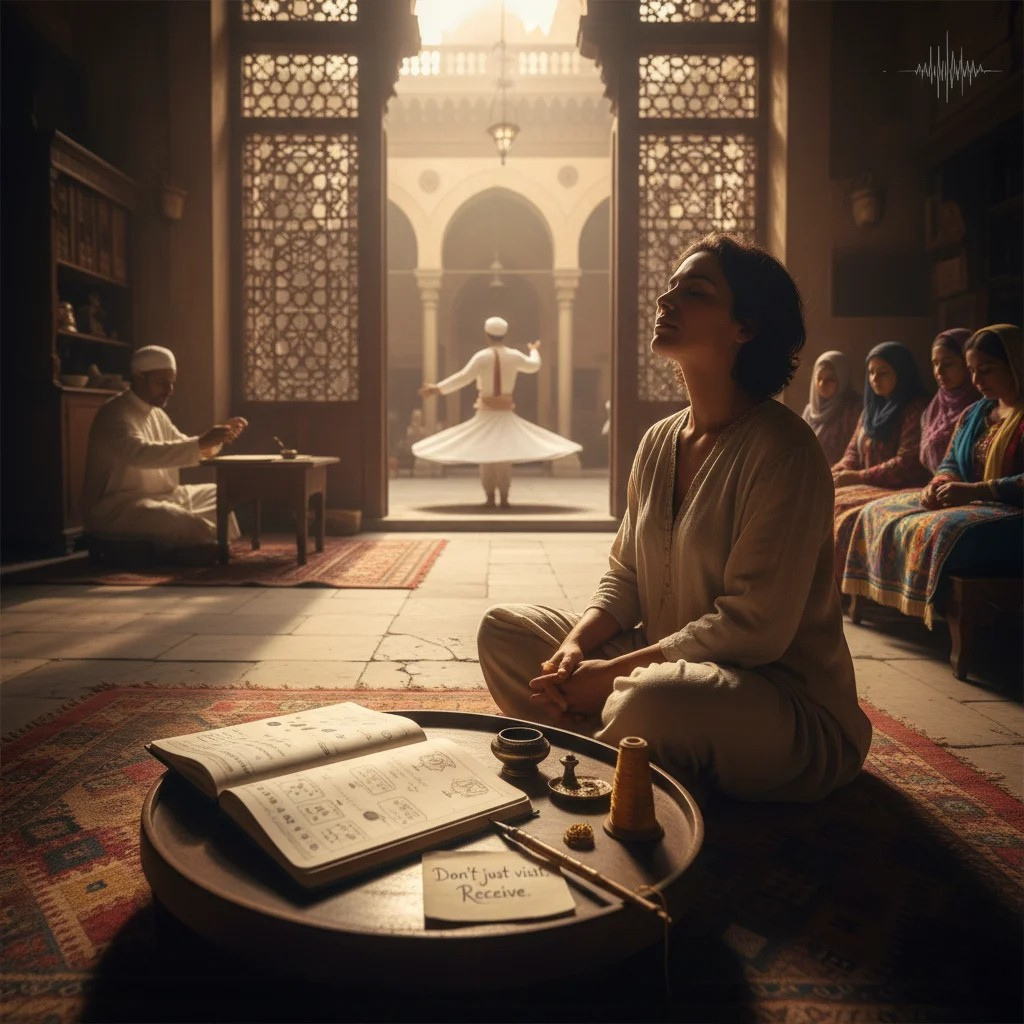
We will explore a range of spiritual and cultural experiences that will enrich your trip:
- First: Attending a sermon or religious lesson at Al-Azhar: As mentioned, Al-Azhar Mosque is a beacon of Islamic knowledge and a destination for Muslims from all over the world, thanks to the vast knowledge of its scholars. Attending the weekly lessons in jurisprudence and Quranic exegesis is a wonderful opportunity to learn from them. These lessons are free and open to everyone, and you can find the schedule at the Visitors Center.
- Second: Learning Arabic calligraphy and architectural design: Al-Azhar holds workshops in Islamic arts at Darb 1718 (near Al-Muizz Street). To register, visit the website ( darb1718.com ).
- Third: Experiencing the spiritual atmosphere of Ramadan: This year, Ramadan will fall between February 19th and March 16th. During this time, Islamic Cairo is adorned and sparkles with decorations and lanterns in the streets and mosques, which are filled with worshippers performing the Taraweeh prayers led by renowned Quran reciters. You can also enjoy strolling through the markets at night, where traditional sweets are displayed.
Note: Non-Muslims are welcome to observe—dress modestly and avoid eating/drinking in public during daylight.
These experiences deepen your Islamic Cairo guide 2026 journey from tourist to witness.
6. Practical Tips for Visitors in 2026.

Here are some important tips before your visit:
- First: Regarding clothing, men should wear modest attire with long sleeves and trousers. Women should wear a long skirt and a headscarf when visiting mosques. Shoes must be removed before entering mosques and placed in designated areas.
- Second: Photography is permitted in streets and public squares but prohibited inside mosques during prayer times. Generally, you should ask permission before taking photos.
- Third: For transportation, you can take the metro to Al-Azhar station or use taxis like Uber to reach your desired location. It is preferable to travel with a licensed tour guide.
- Fourth: For safety and health precautions, drink bottled water and carry hand sanitizer. The crime rate is low, but beware of pickpockets in crowded markets. Trained tourist police officers who speak English are present; their emergency number is 126.
Respect and preparation are the foundation of any meaningful Islamic Cairo guide 2026.
7. Ethical Engagement: Travel with Reverence.
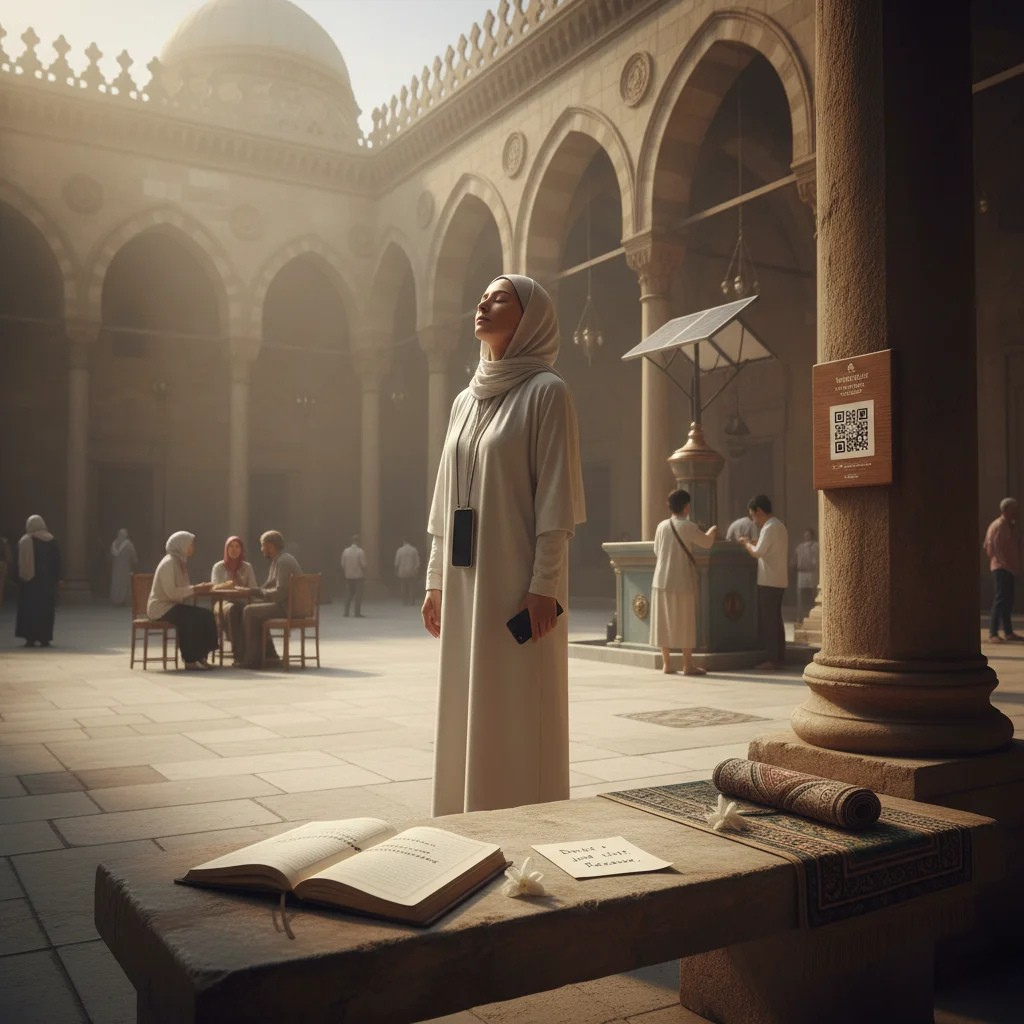
First: When strolling through Khan El-Khalili, it would be wonderful to support the artisans by purchasing their products as a souvenir.- Second: Avoid free tours with unlicensed guides and always choose a licensed guide if you wish to go on a tour.
- Third: When visiting historical mosques, it would be a wonderful gesture to donate a small amount (between 50 and 100 Egyptian pounds) to contribute to their upkeep. This is a way of showing appreciation for these places and participating in the community.
- Fourth: It is important to maintain quiet in mosques and while walking through the courtyards and alleyways.
As the Mamluks believed: “The beauty of a city is measured by the dignity of its people.”
This ethos is central to Islamic Cairo guide 2026.
8. When to Visit Islamic Cairo in 2026.
| Season | Pros | Cons |
| October–April | Mild temps (20–28°C), ideal for walking | Peak tourism (Dec–Jan = crowded) |
| May–September | Fewer crowds, lower prices | Extreme heat (40°C+); avoid midday |
| Ramadan 2026 | (Feb 18–March 16) Spiritually electric, beautiful lights | Restaurants closed during daylight; some sites close early |
Best Window: February or November—cool, clear, and culturally alive.
Timing enhances every Islamic Cairo guide 2026 experience.
9. Recommended Guided Tours (2026).
- First: When visiting Al-Azhar Mosque to learn about its heritage and history, this should be coordinated with specialists from within Al-Azhar.
- Second: To appreciate Mamluk architecture, you should visit the Mosque of Sultan Hassan and the Qalawun Complex.
- Third: To enjoy a nighttime stroll, visit Khan el-Khalili, meet the coppersmiths and lantern makers, and relax at El-Fishawy Cafe.
Book through Egypt Tourism Authority (egypt.travel) to ensure certified, ethical operators.
10. Common Mistakes to Avoid.
We will discuss a number of important things to avoid:
- First: Do not visit mosques during prayer times, as they are closed to tourists.
- Second: Not wearing modest clothing will result in being denied entry, as this is considered disrespectful to the sanctity of the place and the worshippers.
- Third: Ignore the Friday prayer time; you will find all sites closed at that time.
Avoid these to honor the spirit of Islamic Cairo guide 2026.
11. Hidden Gems Only Locals Know.
- Beit Al-Suhaymi is an Ottoman house that retains its original mashrabiya (latticework screen) and gardens.
- Wakalat Al-Ghuri is a commercial building that was used to house visiting merchants, store and sell goods, and conduct business transactions.
- Sabil-Kuttab Nafisa Al-Bayda, also known as Sabil Nafisa Khatun, is a unique example of Ottoman sabils.
- Al-Darb Al-Ahmar district is a center for traditional crafts and is famous for its skilled artisans specializing in arabesque, mother-of-pearl inlay, and traditional woodwork. It is located near Al-Azhar Mosque and Khan Al-Khalili.
These treasures elevate your Islamic Cairo guide 2026 beyond the obvious.
12. Future of Islamic Cairo: Preservation & Innovation.
By 2026, key initiatives include:
- Youth Training: Programs teaching restoration to local teens
- Digital Archiving: 3D scanning of all monuments by Al-Azhar and MIT
- Sustainable Tourism: Limits on daily visitors to fragile sites
Your visit supports these efforts—making Islamic Cairo guide 2026 part of a living legacy.
13. Final Reflection: More Than Stone—A Living Faith.
Islamic Cairo is not a museum frozen in time. It is a city where faith breathes, knowledge flows, and beauty serves the divine. To walk its streets is to walk with history—not as a spectator, but as a guest in a thousand-year conversation between earth and eternity.
So come with humility. Listen more than you speak. And let Islamic Cairo guide 2026 be your compass to a place where every stone whispers “Bismillah.”
Trusted Resources (2026).
- UNESCO – Historic Cairo:
Historic Cairo – UNESCO World Heritage Centre - Al-Azhar University – Visitor Info:
https://www.azhar.eg - Egypt Ministry of Tourism – Islamic Cairo:
https://www.egypt.travel/islamic-cairo - Aga Khan Trust – Cairo Restoration:
1-https://www.akdn.org ……. 2- https://the.akdn/en/where-we-work/middle-east/egypt/historic-cities-programme-egypt - Darb 1718 – Cultural Center:
https://www.darb1718.com
Always verify prayer times and site access before visiting.
Follow us on:
Articles that might interest you :
Sharm El Sheikh vs Hurghada 2026: Which Red Sea Destination Is Better for You and Your Family?
Best Beach Cities in Egypt 2026: Your Ultimate Guide from the Red Sea to the Mediterranean.