AI-Powered Smart Travel: How to Use ChatGPT and Google Gemini to Plan Your Perfect Trip in 2025.
Posted in :

Introduction: The Dawn of Intelligent Itinerary Design
Remember when planning a trip meant stacks of guidebooks, messy spreadsheets, and juggling a dozen browser tabs just to book a flight and hotel? That’s over. In 2025, AI travel planning isn’t here to replace your sense of adventure—it just supercharges it.
Thanks to the latest language models, like OpenAI’s ChatGPT (GPT-4.5) and Google’s Gemini Advanced, travelers can now build detailed, personalized itineraries in minutes. Want to figure out Senegal’s visa rules or find a silent retreat in Slovenia’s Julian Alps? These AI tools handle real-time context-aware guidance the details and adjust to your budget, your pace, your values—even your mood.
Still, not every AI travel plan hits the mark. If you don’t know how to prompt these tools or check their info, you can end up with bland lists, old details, or hotels that don’t even exist. That’s why this guide gets straight to the point. You’ll learn how to use ChatGPT and Gemini the right way, with real examples, prompt ideas, tips for fact-checking, and ways to blend them into your planning.
So, whether you’re backpacking alone, organizing a family getaway, or chasing luxury, getting the hang of AI travel planning in 2025 doesn’t just make life easier. It gives you an edge.
1. Why AI Travel Planning Is a Game-Changer in 2025

- Planning a trip used to mean drowning in blog posts and guidebooks that never seemed up to date.
- You end up sorting through tons of generic advice—none of it really fits your pace, budget, or whether you want gluten-free food or need step-free access.
AI travel planning flips that whole mess on its head:
- Now, you get recommendations built around your dates, your style, and your wallet.
- It pulls in live info, so you’re not stuck with last year’s restaurant list.
- Want to tweak your plans? Just ask—maybe you want to save a bit more cash or toss in a local cooking class. No problem.
- if you need advice in Spanish, Arabic, or Japanese, AI can handle that too—and translate everything back for you.
Travelers have caught on. Back in 2022, only 12% used AI tools to plan trips. By 2024Skift Report, it’s jumped to 63%, according to(Skift, “AI in Travel 2024”). And it’s not slowing down.
Still, it’s not just about using AI. The real trick is knowing how to get the most out of it wisely.
2. Understanding the Tools: ChatGPT vs. Google Gemini

ChatGPT (OpenAI) – Great for Creative Itineraries and In-Depth Planning
- If you want a trip that tells a story—think “Sufi spiritual journey in Egypt”—ChatGPT really shines. It’s fantastic at building themed trips, adding history or local flavor, and organizing everything in neat tables or lists.
- The free version (GPT-3.5) doesn’t pull in live updates, so it can’t check the latest events or prices.
- The paid GPT-4 with browsing can search the web, but it sometimes skips over smaller blogs. Still, if you need multi-day plans with personality or want to set a mood, this is the tool for you.
Google Gemini (Formerly Bard) – Best for Live Info and Smooth Integration
- Gemini’s all about real-time details. It hooks directly into Google Flights, Hotels, Maps, and even Gmail, so you get up-to-the-minute prices, pictures, and reviews without digging around.
- It’s not as imaginative as ChatGPT, but it’s perfect when you need to check what’s available, compare costs, or figure out your transport. If logistics matter more than storytelling, Gemini’s the way to go.
Pro Insight: Use both. Draft your dream itinerary with ChatGPT, then validate logistics with Gemini.
This synergy defines modern AI travel planning—creativity meets verification
3. Step-by-Step: How to Plan a Trip Using AI (With Real Prompts)

Step 1: Define Your Core Parameters
Never start with “Plan my trip.” Instead, feed AI rich context:
Prompt Template:
“I’m planning a 10-day trip to Italy in May 2025 with my partner. We love slow travel, authentic food, and avoiding crowds. Budget: $3,000 total (excluding flights). We’re vegetarians and prefer boutique stays or agriturismi. Focus on one region—suggest best base towns and daily rhythms.”
This yields a structured plan, not a generic list.
Step 2: Generate a Thematic Itinerary
Ask for narrative depth, not just sights:
Prompt:
“Create a 7-day slow travel itinerary in Puglia, Italy, centered around olive oil, trulli architecture, and coastal walks. Include:
- Daily themes (e.g., ‘Day 3: White Cities & Seafood-Free Puglian Cuisine’)
- Specific towns to stay in (max 2 bases)
- Local food experiences (vegetarian-friendly)
- Transport between towns (train/bus/car?)
- One hidden gem locals love”
ChatGPT Output Example:
Day 4: Olive Oil & Orecchiette in Alberobello → Morning visit to a family-run frantoio (olive mill); lunch at a masseria cooking class making orecchiette with broccoli rabe; afternoon stroll through the quieter Monti district; dinner at Trattoria Terra Madre (100% veg menu).
This is AI travel planning at its best: contextual, sensory, and actionable.
Step 3: Validate with Google Gemini
Paste the itinerary into Gemini and ask:
“Check availability for agriturismi near Alberobello for May 10–17, 2025, under $120/night. Show real options from Google Hotels with photos and reviews.”
Gemini will pull live listings, complete with ratings and booking links.
4. Advanced AI Travel Planning Techniques (2025 Edition)

A. Multi-City Routing Optimization
Prompt:
“I want to visit Lisbon, Porto, and the Douro Valley in 8 days. I’ll arrive in Lisbon and depart from Porto. Optimize the route to minimize backtracking. Include train times from CP.pt and suggest where to stay each night.”
AI cross-references official rail schedules (when browsing is on) to build efficient loops.
B. Budget Breakdowns
Prompt:
“Break down a realistic daily budget for a mid-range traveler in Slovenia (2025): accommodation, food, transport, activities. Include seasonal variations (summer vs. spring).”
Output includes local price averages (e.g., “Farmhouse dinner: €18–25”).
C. Accessibility & Inclusivity Planning
Prompt:
“Plan a wheelchair-accessible 5-day itinerary in Kyoto, Japan. Include:
- Fully accessible ryokan or hotels
- Barrier-free temples and gardens
- Accessible public transport options
- Restaurants with wide aisles”
AI can now filter for inclusivity—a major leap in ethical AI travel planning.
D. Visa & Entry Requirement Synthesis
Prompt:
“I’m an Egyptian passport holder traveling to Georgia, Armenia, and Azerbaijan in June 2025. Summarize visa requirements, e-visa links, and processing times for each.”
AI pulls from official government portals (when browsing enabled).
5. Avoiding Pitfalls: Limitations and Verification
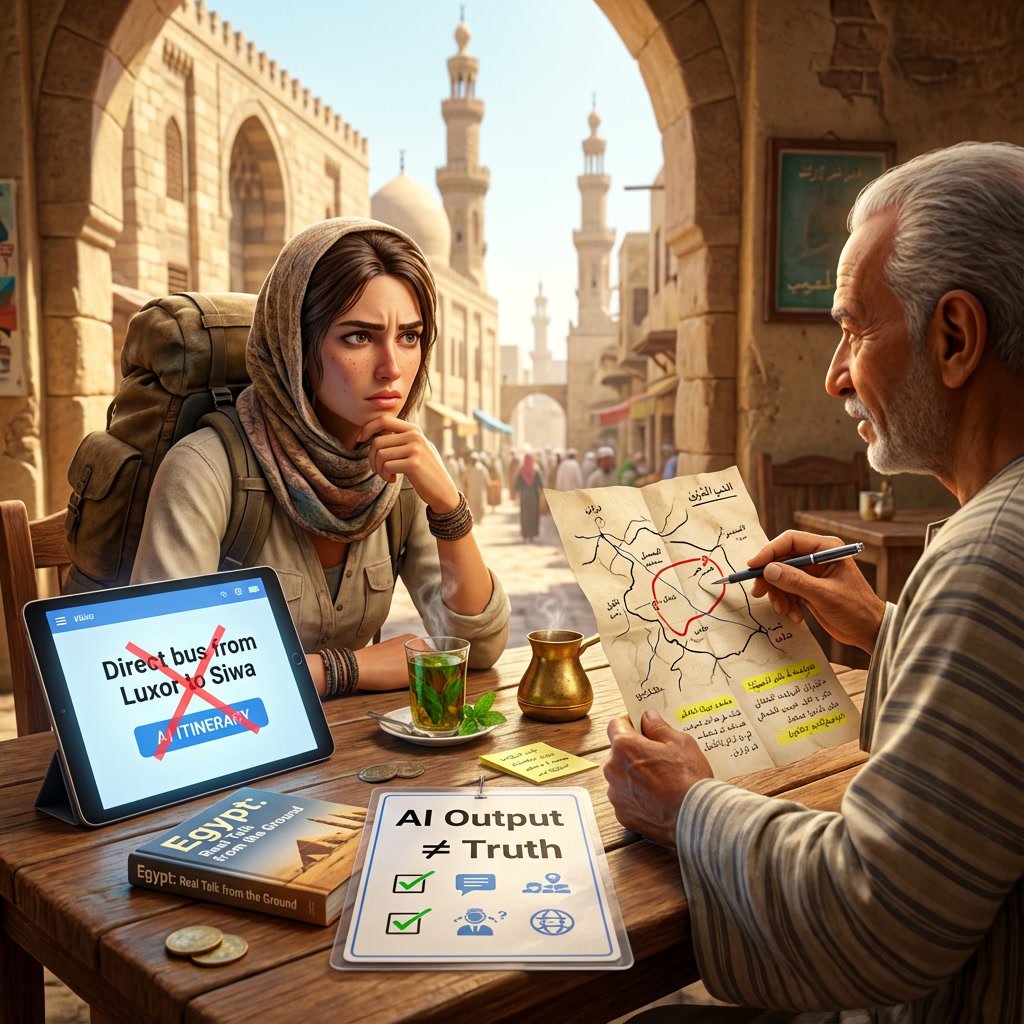
AI is a handy tool for travel planning, but it’s got its flaws. Here’s where things can go sideways:
A. Made-up Details
- Sometimes AI just invents stuff. You might get a recommendation for a hotel that doesn’t exist (“Hotel Soleil Cairo”) or a train route that no one’s ever heard of.
- Don’t take it at face value—double-check hotel names and train schedules on official sites like EgyptAir, Trenitalia, or the Japan Rail Pass page.
B. Old Info
- Free versions of ChatGPT only know what happened up to June 2024. So, if a cool new museum opens in 2025, you’ll miss it.
- If you need the latest updates, use a paid GPT-4 with browsing or just search with Google Gemini, and make sure to confirm anything important.
C. Too Basic
- AI loves sticking to the classics. It might always send you to Rome instead of somewhere quieter like Le Marche, or pick Bali over somewhere unique like Lake Monoun.
- If you want something different, be clear—ask for “off-the-beaten-path” places or mention the specific region you’re interested in.
Golden Rule: AI suggests, you verify. Never book based solely on AI output.
6. Real-World Case Study: Planning a Sufi Spiritual Journey in Egypt

Let’s apply AI travel planning to a niche interest:
User Prompt:
“I want a 6-day spiritual journey in Egypt focused on Sufi heritage. Include:
- Dhikr ceremonies at Sayyida Zeinab (Cairo) and Sayyid al-Badawi (Tanta)
- Modest, safe accommodations near mosques
- Cultural etiquette for non-Muslim visitors
- Best time to visit in 2025 to avoid heat and crowds”
Here’s what stands out:
- October’s the sweet spot—mulid season’s in full swing, and the weather’s actually decent.
- If you want to stay in Islamic Cairo, there are some solid, budget-friendly guesthouses like the Orient House Hotel.
- Heads up for women: pack a headscarf, and don’t even think about snapping photos during dhikr.
- If you’re eyeing Tanta’s mulid, know this—it’s massive. Two million people show up. If you want a room, book at least three months in advance.
Gemini Verification:
- Double-checking the details, Orient House has rooms in October 2025.
- You can walk to Sayyida Zeinab Mosque—Google Maps has the route.
- For the nitty-gritty on Sufi tourism, Egypt’s Tourism Authority breaks it down.
Honestly, this is what AI travel planning looks like now. You toss out ideas, refine them, and then back them up with solid info.
7. Integrating AI with Traditional Tools

AI doesn’t replace apps—it enhances them:
| Task | AI Role | Human/Tool Role |
| Itinerary Draft | ChatGPT creates narrative plan | Google Calendar for scheduling |
| Price Check | Gemini shows live hotel rates | Booking.com for booking |
| Navigation | AI describes routes | Google Maps for real-time transit |
| Document Prep | AI summarizes visa rules | Official e-visa portal for application |
The smart traveler uses AI for ideation, humans for execution.
8. Ethical Considerations in AI Travel Planning

Artificial intelligence-based travel advice must be done responsibly:
- Over-tourism: Tell the model to look for alternative destinations to popular sites. (“Instead of Cinque Terre, suggest other coastal villages that aren’t as crowded.”)
- Supporting local economies: Ask for the system to favor family-owned guesthouses and local guides.
- Respect cultural context: Use the power of AI to learn good manners, rather than trying to ‘hack’ or get around ‘sacred spaces.’
As UNESCO notes in its 2024 report:
“AI can democratize travel knowledge—but only if it centers local voices and sustainability.”
(UNESCO – AI & Cultural Heritage, 2024)
9. The Future: What’s Next for AI Travel Planning?

By late 2025, one can expect that:
- Voice-controlled artificial intelligence-based travel agents, such as “Ok Google, re-book my train if it’s delayed”
- Augmented Reality Views where the AI creates a three-dimensional model of a Hotel room
- Carbon footprint calculation tools integrated into itinerary planners
- Live crisis notifications for strikes, protests, or weather-related events, all of which are monitored through news using AI .
The merging of planning and companionship, representing a new era of active and understanding AI-assisted travel planning .
10. Prompt Library: 10 Ready-to-Use Templates

- For Families:
“Plan a 7-day Egypt itinerary for a family with kids (ages 8 & 12). Focus on interactive, educational sites. Include child-friendly hotels near Giza with pools.” - For Solo Women:
“Suggest a safe, enriching 5-day itinerary in Portugal for a solo female traveler. Prioritize well-reviewed guesthouses, group tours, and daytime activities.” - For Budget Travelers:
“Create a $50/day itinerary in Georgia (country) for June 2025. Include hostels, street food, free walking tours, and intercity transport.” - For Luxury Seekers:
“Design a 10-day luxury honeymoon in Italy: private villas, Michelin-starred meals, and unique experiences (e.g., after-hours Vatican tour).” - For Slow Travelers:
“Recommend one region in Slovenia for a 2-week slow travel stay. Include a farmhouse rental, local markets, hiking trails, and cultural festivals in September.” - For Visa-Free Travel:
“List 5 visa-free destinations for UAE passport holders in 2025 with direct flights from Dubai. Include best times to visit and unique experiences.” - For Adventure Travelers:
“Plan a 12-day trekking itinerary in the Atlas Mountains, Morocco. Include certified guides, eco-lodges, and cultural immersion with Berber families.” - For Cultural Immersion:
“Create a 6-day Kyoto itinerary focused on traditional crafts: tea ceremony, kimono weaving, kaiseki cooking. Include workshops that accept foreigners.” - For Last-Minute Trips:
“Suggest a 4-day beach getaway from London in May 2025 under £600 total. Prioritize direct flights and boutique hotels with sea views.” - For Sustainable Travel:
“Plan a zero-plastic, carbon-offset 8-day trip in Costa Rica. Include eco-lodges, wildlife sanctuaries, and local cooperative tours.”
These prompts turn AI travel planning into a precision tool.
11. Final Verdict: AI as Your Co-Pilot, Not Captain

AI travel planning in 2025 is not about removing the human element—it’s about enhancing human intention. AI handles the data crunching; you bring the heart, intuition, and final judgment.
Used wisely, ChatGPT and Google Gemini can save you 10+ hours of research, uncover hidden gems, and help you travel more deeply, safely, and sustainably.
So embrace the future—but keep your passport, your curiosity, and your critical mind firmly in hand.
Conclusion: Travel Smarter, Not Harder

In 2025, the most prepared traveler isn’t the one with the bulkiest guidebook—but the one who knows how to ask the right questions of the right AI. By mastering AI travel planning with ChatGPT and Google Gemini, you’re not just saving time. You’re unlocking deeper, more intentional, and more joyful journeys.
So go ahead: prompt, refine, verify, and explore. The world is waiting—and now, you have an intelligent co-pilot by your side.
Trusted Sources & Verification Tools (2025)
Official Tourism Portals:
- Slovenia: https://www.slovenia.inf
- Egypt: https://www.egypt.travel
- Italy: https://www.italia.it
Transport Authorities:
- Trenitalia (Italy): https://www.trenitalia.com
- CP (Portugal): https://www.cp.pt
Visa Information:
- IATA Travel Centre: https://www.iatatravelcentre.com
Sustainability Certifications:
- Green Key: https://www.greenkey.global
Follow us on:
Articles that might interest you :
- The Best Accommodation Booking Apps in 2025 – Travel Experts Prefer These!.
- Slow Travel in Europe: Your Practical Guide to Discovering Italy, Portugal, and Slovenia in Depth.