


Introduction: Egypt Awaits with Open Arms and Open Hearts.
Egypt holds immense spiritual significance for many Muslim travelers, who consider it their home. It has preserved Islamic traditions for over 1,300 years, evident in its numerous mosques and shrines, Sufi angles, and Al-Azhar University, one of the oldest Islamic universities in the world. However, many Muslim families, solo travelers, and those who prefer halal food still have questions about Egyptian hospitality, the ease of finding prayer spaces, and the quality of halal food.
The Muslim-friendly travel in Egypt has been expressed as a national priority. This is clearly demonstrated by the Egyptian government’s efforts to develop Islamic sites and landmarks, as well as the operation of clean, government-approved halal restaurants and hotels equipped with Qibla direction indicators and prayer rooms, either dedicated to the site or integrated into the existing infrastructure. This guide enables Muslims to navigate Egypt during their trip, visiting with ease and peace of mind, enjoying an enriching spiritual experience, spending enjoyable family vacations, and exploring diverse cultural aspects.
This article is based on data from 2025-2026 provided by the Egyptian Ministry of Tourism and actual tourists who traveled there.
1. Why Egypt Is a Top Destination for Muslim-Friendly Travel in 2026.

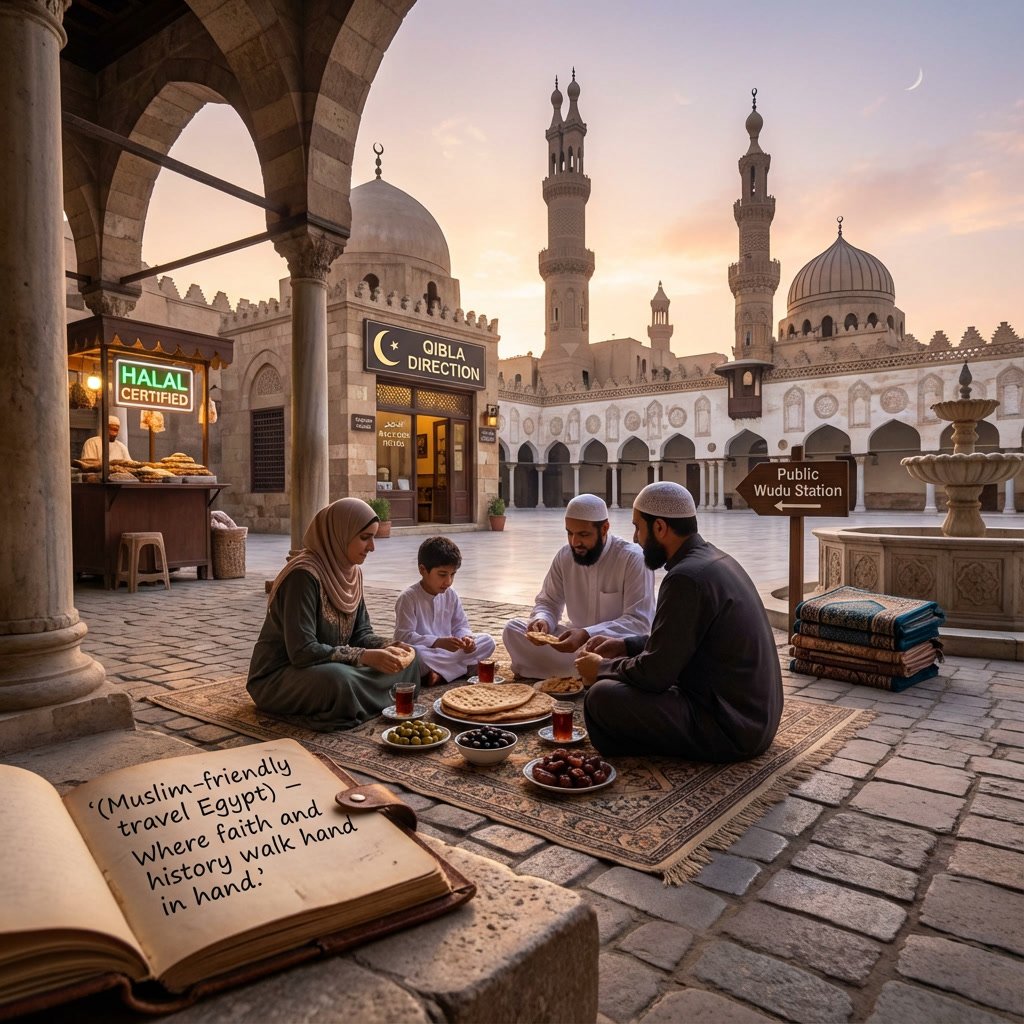
We will discuss the reasons why Egypt is a major tourist destination for Muslims:
- First: This is clearly evident in Egypt, specifically in Cairo, which boasts numerous Islamic heritage sites. Cairo has over 5,000 mosques, shrines, and Islamic sites, including Al-Azhar Mosque and the Museum of Islamic Art. All of these are UNESCO World Heritage Sites. Furthermore, Egypt’s major mosques are among the most important Islamic mosques in the world.
- Second: The Egyptian government launched a halal tourism initiative as part of its Vision 2030, aiming to make Egypt a Muslim-friendly destination (Egypt Ministry of Tourism, 2025). This initiative includes:
- Granting halal certification to restaurants and hotels that meet Islamic standards.
- Providing large tablets in every mosque displaying prayer times, along with an electronic application containing prayer times, a collection of supplications and invocations, and Quranic chapters recited by Egyptian reciters.
- Training tourism sector employees on Islamic customs and traditions.
For Muslim travelers, this means more than convenience—it means dignity, ease, and spiritual alignment.
2. Understanding “Muslim-Friendly Travel Egypt”: What It Really Means.

We will discuss the reasons why Egypt has always been a favorite and friendly destination for Muslims:
- First: Easy access to places of worship: This is due to the abundance of mosques, which are always clean and peaceful, and the ability to accurately determine prayer times.
- Second: Guarantee of halal food: Because Egypt is a Muslim country, all restaurants and hotels offer clean and halal food, which reassures Muslim tourists.
- Third: Egyptian customs and traditions: These uphold and respect modesty, as evidenced by the fact that accommodations and transportation respect the hijab and generally treat women with respect.
- Fourth: Spiritual enrichment: Many of Egypt’s major mosques host Sufi dhikr circles and sessions for learning the Quran and religious sciences.
Unlike generic “halal travel” lists, this guide focuses on verified, on-the-ground realities—not marketing claims.
3. Prayer in Egypt: Mosques, Times & Facilities (2026 Update).

We will discuss prayer in Egypt, focusing on mosques, prayer times, and facilities:
- First: Regarding prayer, Egypt follows the Umm al-Qura calendar for determining prayer times. However, there are slight variations in the times of the Adhan (call to prayer) and Iqamah (second call to prayer) from one city to another. For example:
- Cairo: For instance, prayer times in Cairo differ from those in Luxor and Aswan by five minutes. Adhan programs (approved by Al-Azhar) and the Muslim Pro program (set to Egyptian time) are also available.
- Important note: Most mosques broadcast the Adhan via loudspeakers, a natural reminder throughout the day.
- Second: Regarding mosques, Egypt boasts many grand mosques with a rich Islamic heritage. They are among the largest and most historically significant mosques in the world and are open to tourists outside of prayer times. Examples include:
- Al-Azhar Mosque (Cairo): Built in 970 AD, it is open outside of prayer times. Women are required to cover their hair, and an abaya (cloak) is provided at the entrance.
- The Sayyida Zeinab Mosque (Cairo): This mosque is sacred to Muslims worldwide because it houses the shrine of Sayyida Zeinab, the granddaughter of the Prophet Muhammad (peace and blessings be upon him), who is buried there. Visitors come to her shrine out of love for her, her life, and her grandfather, the Prophet Muhammad (peace and blessings be upon him and his family and companions). It is open to visitors outside of prayer times and has separate prayer halls for women, as well as clean and shaded ablution areas.
- The Muhammad Ali Mosque (Cairo Citadel): An Ottoman architectural masterpiece located within the Citadel of Saladin, it was built by Muhammad Ali Pasha in the style of the Sultan Ahmed Mosque in Istanbul. It features a massive dome, the tomb of Muhammad Ali, and a copper clock tower gifted by Louis Philippe, King of France. It is open to visitors from 9:00 AM to 4:00 PM, except during prayer times when it is closed.
- Al-Hussein Mosque (Cairo): This mosque is considered sacred because it houses the shrine of Sayyidna al-Hussein, the grandson of the Prophet Muhammad (peace and blessings be upon him), who is buried there. People come to visit out of love for him, his life, and his grandfather, the Prophet Muhammad (peace and blessings be upon him and his family and companions). It is considered the center of Islamic Cairo, and Quranic recitations are held there at night during Ramadan. It is open to visitors outside of prayer times.
- Abu al-Abbas al-Mursi Mosque (Alexandria): This mosque is a major and important pilgrimage site for Muslims because it contains the shrine of Sayyidna Abu al-Abbas al-Mursi, one of the great Muslim scholars and a righteous man. It is one of the largest mosques in Africa, distinguished by its beautiful architecture and spacious prayer halls.
- Important Note: Non-Muslims are welcome in most mosques outside of prayer times. Please dress modestly and remove your shoes.
- Thirdly: Regarding facilities, there are many facilities designed for Muslims to perform their prayers in places where there are no mosques, such as:
- Egyptian airports: These have clean prayer rooms and ablution areas.
- Shopping malls: City Stars, Mall of Egypt, and Cairo Festival City all offer clean, air-conditioned prayer rooms.
- Hotels: Many hotels provide prayer mats in their rooms and usually display the Qibla direction.
This infrastructure makes Muslim-friendly travel Egypt seamless—even in transit.
4. Halal Food in Egypt: What’s Guaranteed (and What’s Not).

We will discuss everything related to food in Egypt, specifically regarding halal and non-halal:
- First: According to Egyptian law, which is in accordance with Islamic Sharia, all food served in restaurants and hotels is halal. The meat of animals is slaughtered according to Islamic law. Pork is only found on a limited scale in international hotels and Christian homes.
- Second: Regarding restaurants that offer halal and good quality food, there are:
- Kazaz Restaurant (a place that serves Levantine cuisine and has a prayer room).
- Sofra Restaurant in Luxor: It offers delicious halal food, has a garden, and is located near Karnak.
- Al-Masry Restaurant in Aswan: It serves delicious Egyptian dishes alongside Nubian cuisine, all of which are halal.
- Local restaurants: These serve popular Egyptian dishes such as koshari, falafel, and ful medames, all of which are halal.
This clarity ensures Muslim-friendly travel Egypt includes peace of mind at every meal.
5. Best Hotels for Muslim-Friendly Travel Egypt (2026).
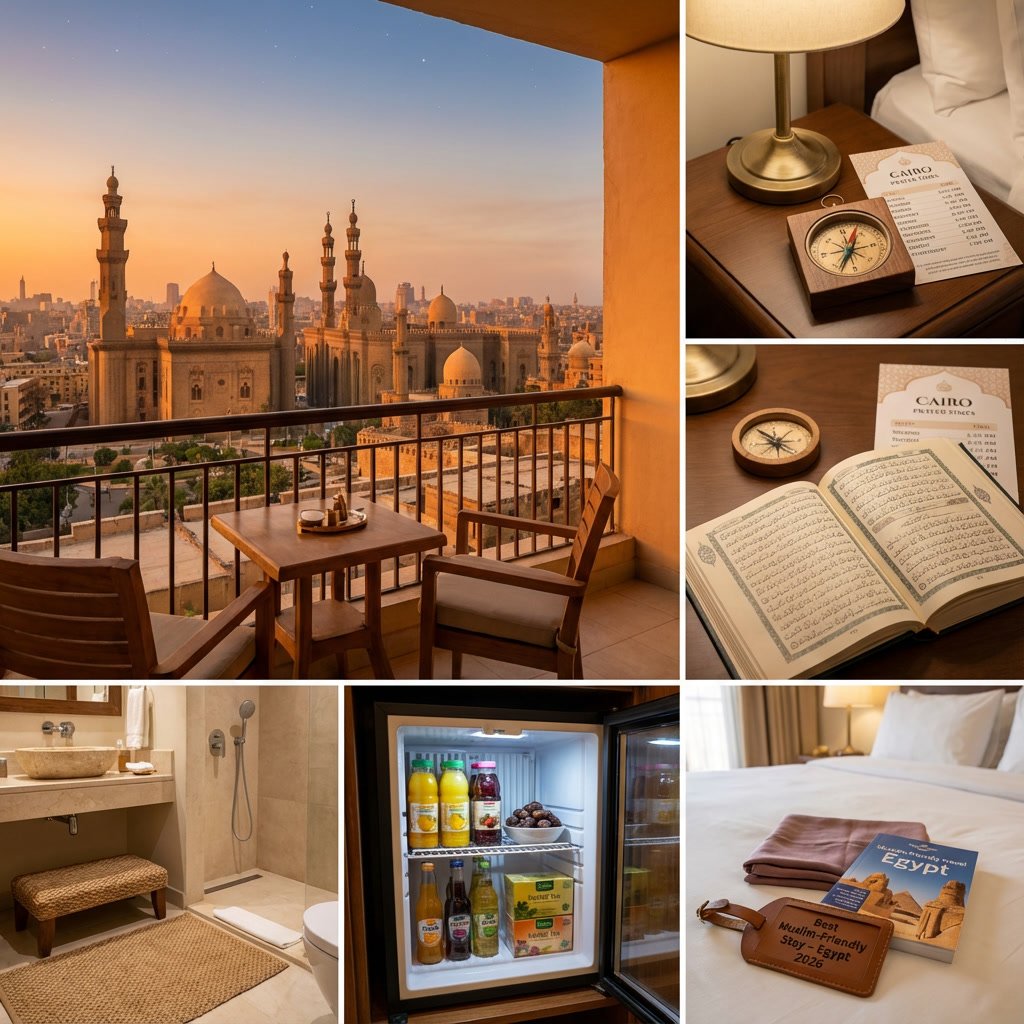
We will mention the best hotels to stay in and their proximity to Islamic sites:
- First: Regarding the best hotels in Cairo near Islamic sites, they are:
- Steigenberger Tahrir Hotel: This hotel is located in the heart of the capital, minutes away from Al-Azhar Mosque, Khan El-Khalili, Al-Muizz Street, and Islamic sites. The hotel provides individual prayer mats with prayer direction indicators in the guest rooms and has a restaurant serving halal food, certified by the Halal Tourism Program in Egypt.
- Sayeda Zeinab Hotel: This hotel is located near Sayyida Zeinab, and the mosque and shrine are within a two-minute walk. The rooms are clean and comfortable, and there are family rooms available.
- Second: Regarding the best hotels in Alexandria, they are:
- Helnan Palestine Hotel: Located in the Montazah district, it is about 30 minutes from the city center and the Sidi Abu al-Abbas al-Mursi Mosque. It includes a prayer room, a restaurant serving halal food, and overlooks the sea.
- Third: The best hotels in Luxor and Aswan, offering a balance between cultural and spiritual experiences:
- Sofitel Winter Palace Hotel (Luxor): This hotel boasts a prime location near Luxor Temple. It offers halal food, has a prayer room, and provides prayer rooms and a Qibla direction indicator for Muslim guests upon request.
- Pyramisa Island Hotel, Aswan: This hotel overlooks the Nile River and also offers halal food. It has a prayer room and provides prayer services in the guest rooms upon request.
Booking Tip: Use filters on Booking.com (“Halal Food,” “Prayer Room”) or HalalBooking.com for verified options.
These hotels exemplify how Muslim-friendly travel Egypt blends faith, comfort, and location.
6. Spiritual Experiences: Beyond Sightseeing.

We will explore a selection of enriching spiritual experiences in Egypt:
- First: The Sayyida Zeinab Mosque (Cairo): Muslims visit the shrine of Sayyida Zeinab, a place of spiritual enlightenment and tranquility. Sufi dhikr sessions are held in the mosque every Thursday, along with study circles and Quran memorization classes.
- Second: The Sayyid al-Badawi Mosque (Tanta): This mosque includes the shrine of Sayyid Ahmad al-Badawi, a revered and righteous Muslim scholar and a descendant of the Prophet Muhammad (peace and blessings be upon him and his family and companions). Muslims visit the shrine seeking spiritual enlightenment and blessings, especially during the Prophet’s birthday celebrations, which are peak tourist season in Egypt for Muslim visitors interested in Sufism.
- Third: Al-Azhar Mosque and University: These can be visited by arranging a guided tour with specialists in Islamic culture and sites. These tours can be booked through the official website of the Ministry of Religious Endowments (The official platform of the Ministry of Awqaf).
- Fourth: Ramadan Iftar tents: The major Islamic mosques (Al-Azhar, Al-Hussein) provide free group Iftar meals called “Tables of Mercy,” after which the Taraweeh prayer is held, and every night there is a reciter of the Holy Quran. The atmosphere in this month is filled with spirituality, and the streets are lit with lanterns.
These experiences transform your trip from tourism to spiritual journey—the heart of Muslim-friendly travel Egypt.
7. Transportation & Modesty: Navigating with Ease.

We will discuss a set of important tips regarding transportation and clothing in Egypt:
- First: Regarding transportation options available in Cairo, for example:
- The Metro System: This is fast and safe, reaching most tourist attractions. It features women-only carriages and operates daily from 5:00 AM to midnight.
- Taxis: Clean, modern, and safe taxis are available. You can book them through the Uber Egypt or InDriver apps, or coordinate with your hotel or tour company to arrange safe vehicles. Be wary of unidentified vehicles.
- Trains or Flights: These services are available for travel to other cities. Trains offer various classes of service, are air-conditioned, and are of high quality. You can book through this link (https://www.enr.gov.eg/En/). Flights are available from every tourist city in Egypt, offering faster and shorter arrival times.
- Secondly, regarding appropriate attire:
- City: When walking around cities, long-sleeved clothing and trousers that fall below the knee are recommended, as modest dress is preferred but not mandatory.
- Mosques: Men should wear a headscarf and long trousers.
Egypt is culturally conservative yet welcoming—a balance that supports Muslim-friendly travel Egypt.
8. Safety & Practical Tips for Muslim Travelers.

1-Women Traveling Solo
- Choose hotels that have good reviews and female staff.
- At night, order “Uber Women.”
- Bring a scarf to shade you from the heat and to visit mosques.
2-Families
- Most hotels also offer family suites that have separate living rooms.
- Children can be taken to restaurants and mosques.
3-Halal Food Assurance
- If in doubt, eat in Egyptian restaurants – these are Halal.
- In large hotels and resorts, you should inquire about the availability of halal food.
4-Emergency contacts
- Tourist Police: 126 (English-speaking)
- Ministry of Awqaf Hotline: 19500 (for religious guidance)
Egypt’s infrastructure ensures Muslim-friendly travel Egypt is not just possible—but deeply comfortable.
9. Itinerary Suggestion: 4-Day Muslim-Friendly Egypt Trip (2026).

Here’s a perfect 5-day itinerary for Muslims in Egypt:
- Day 1: We’ll start the day with a visit to Al-Muizz Street, followed by a visit to Al-Azhar Mosque in the morning. At midday, we’ll go to Naguib Mahfouz’s café and restaurant for lunch, followed by mint tea and a wonderful literary session. In the afternoon, we’ll take a stroll through Khan El-Khalili. In the evening, we’ll visit El-Fishawy Café, where the renowned writer Naguib Mahfouz used to frequent, enjoying the truly enchanting atmosphere.
- Day 2: We’ll spend this day in the Sayyida Zeinab district, where spirituality permeates the area. In the morning, we’ll visit the shrine of Sayyida Zeinab (may God be pleased with her), the granddaughter of the Prophet Muhammad (peace and blessings be upon him), and stay there until midday. Then, we’ll head to El-Refa’i Restaurant, one of the most famous Egyptian restaurants serving delicious Egyptian cuisine. In the afternoon, we’ll visit the Museum of Islamic Art. In the evening, we’ll return to Sayyida Zeinab Mosque to attend the Sufi dhikr gatherings held every Thursday. We recommend doing this on a Thursday.
- Day 3: We will spend this day in Alexandria, traveling there in the morning either by train or car. Upon arrival, we will head directly to the Sidi Abu al-Abbas al-Mursi Mosque or visit the renowned Library of Alexandria, which houses a comprehensive collection of everything related to Islam. At midday, we will visit Abu Ashraf Restaurant, which serves fresh and delicious fish dishes. Later in the afternoon, we will take a wonderful stroll along the charming Alexandria Corniche and try the famous Egyptian dessert, Fresca. In the evening, we will depart for Cairo.
- Day 4: We will spend this day in the New Administrative Capital. We will begin in the morning with a visit to the Al-Fattah Al-Aleem Mosque, followed by a visit to the Egyptian Islamic Cultural Center. Afterwards, we will go to Kazaz Restaurant, which offers delicious halal food. In the evening, we will return to the hotel for dinner and prepare for departure.
This compact itinerary maximizes Muslim-friendly travel Egypt in minimal time.
10. Common Misconceptions Debunked.

- wrong: “Egypt is not safe for Muslim women.”
right: Cairo and Alexandria are safer for hijabi women than many Western cities—modesty is respected, not targeted. - wrong: “Halal food is hard to find outside Cairo.”
right: In Luxor, Aswan, and Siwa, local cuisine is inherently halal, including tourist-trap restaurants. - wrong: “Mosques are closed to tourists.”
right: Most historic mosques welcome respectful visitors outside prayer times—just dress modestly.
Clarity like this is essential to confident Muslim-friendly travel Egypt.
11. Ethical & Respectful Engagement.

- Photography: Never photograph people in prayer or inside shrines without permission.
- Donations: If visiting Sayyida Zeinab, small donations (50–100 EGP) support shrine maintenance.
- Language: Learn “As-salamu alaykum” (Peace be upon you) and “Shukran” (Thank you)—locals appreciate it deeply.
Muslim-friendly travel in Egypt is as much about giving respect as receiving it.
12. Final Verdict: Why Egypt Stands Out for Muslim Travelers.

In 2026, Egypt isn’t just Muslim-friendly—it’s Muslim-celebrating. From the call to prayer echoing over the Nile to the scent of oud in Islamic Cairo, the country offers a living, breathing Islamic experience that textbooks cannot capture.
Unlike destinations that add “halal options” as an afterthought, Egypt’s Muslim-friendly travel Egypt is organic, historic, and heartfelt. You’re not a niche market—you’re a returning guest of a civilization that shaped Islamic thought for centuries.
So come. Pray where scholars once prayed. Eat where Sufis once shared bread. And let Egypt remind you that faith and travel can be one and the same.
Resources for Muslim Travelers (2026).
- Ministry of Awqaf – Visitor Guidance:
The official platform of the Ministry of Awqaf - Egypt Tourism – Muslim Traveler Section:
https://www.experienceegypt.eg/en - HalalBooking.com – Verified Accommodations:
https://www.halalbooking.com
Follow us on:
Articles that might interest you :
Sharm El Sheikh vs Hurghada 2026: Which Red Sea Destination Is Better for You and Your Family?
Adventure Tourism in Egypt 2026: Your Ultimate Guide to Deserts, Oases, Diving & Beyond.