


Introduction: Beyond the Headlines — Real Safety in Modern Egypt.
Lately, the question “Is Egypt safe to travel now?” pops up everywhere—travel blogs, news headlines, even at the dinner table. A lot of people still picture Egypt through a pretty old lens: political chaos from years ago, dramatic news stories, or vague talk of desert dangers. But honestly, if you look at what’s happening there now, Egypt in 2025 feels like a different place.
These days, millions of travelers are heading to Egypt every year. The country’s in the middle of a huge upgrade—think better roads, safer tourist sites, and way more access to culture. Whether you’re lounging on the Red Sea or wandering the narrow streets in Cairo, you’ll see a country working hard to show the world it’s safe, family-friendly, and packed with things to discover.
Of course, “safe” means something different for everyone. If you’re traveling solo as a woman, you’ll probably have different questions than a family with kids or a first-time backpacker. That’s why this guide gets straight to the point—offering honest, up-to-date advice and real info to help you decide if Egypt feels right for you.
We pulled insights from official reports, locals, and recent travelers (including plenty of 2024 and 2025 reviews). You’ll find everything you need—crime stats, health tips, common scams, cultural do’s and don’ts, and how things change from place to place. The goal? So you can head to Egypt feeling smart, safe, and ready for the adventure.
1. The Big Picture: Egypt’s Current Safety Landscape.


Government Commitment to Tourism Security
Egypt started putting serious money into its tourism setup and safety measures back in 2018. The Ministry of Tourism and Antiquities teamed up with the Ministry of Interior on this. They created a Tourism Police Force as a dedicated group. Officers from that force show up at key tourist areas, airports, and hotels. Those folks wear clear blue uniforms that set them apart. They also train in several foreign languages and ways to deal with emergencies.
The government rolled out a big “Egypt is Safe” campaign in 2023. It aimed to tighten security rules at old archaeological spots, cruise ship docks, and routes across the desert. The World Travel and Tourism Council, or WTTC, put Egypt in the top 10 nations for getting tourism back on track after the pandemic hit. Visitor counts topped 14 million by 2024. That really points to how travelers worldwide feel more confident about heading there(WTTC Egypt Report, 2024).
Crime Rates: What the Data Shows
Most people think Egypt is dangerous, but violent crime is actually rare, especially when it comes to tourists. What you’ll run into more often is petty stuff—pickpocketing, getting overcharged—mostly in busy spots like Khan el-Khalili or along Luxor’s corniche. Even then, things hardly ever turn serious.
According to the U.S. Department of State’s April 2025 update, Egypt sits at Level 2: “Exercise Increased Caution.” That’s the same rating as Italy, Spain, or Thailand. Here’s what they say:
- “Tourist areas such as Cairo, Luxor, Aswan, and the Red Sea resorts remain generally safe with enhanced security presence.”
- (U.S. Travel Advisory – Egypt)
Similarly, the UK Foreign Office states:
- “Most visits to Egypt are trouble-free. Standard precautions apply in major cities.”
- (GOV.UK – Egypt Travel Advice)
Notably, both advisories exclude the Sinai Peninsula (north of Nuweiba) and the Western Desert near the Libyan border—regions that are not typical tourist destinations.
2. Is Egypt Safe to travel for Families?
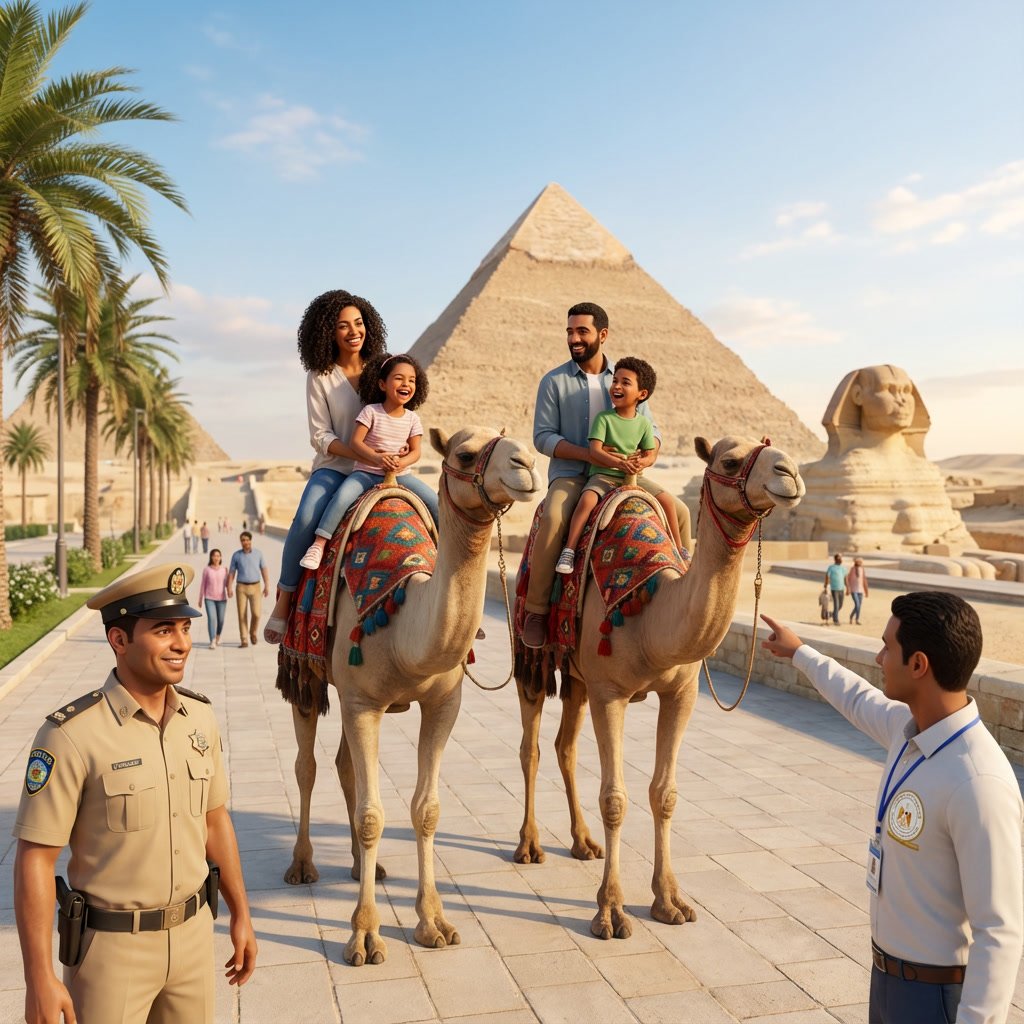
Egypt proves to be very family-oriented. It is very welcoming towards children. There are many opportunities for learning.
Safety Highlights for Families
- Low risk of abduction/exploitation of children: Egypt’s laws are very protective of children, and the culture values children.
- Stroller-friendly sites: Major museums (such as the Grand Egyptian Museum, scheduled to open fully in late 2025) and Nile cruises cater to families.
- Health: Tap water is undrinkable, but you can readily purchase bottled water for a low price. There are also many pharmacies.
Fun Places for the Whole Family
- Cairo: Egyptian Museum, Al-Azhar Park (for a nice sunset), Pyramids of Giza (early morning to avoid the crowds).
- Luxor: Hot air balloon rides in Luxor are safe (offered by companies like Sky Cruise) and very romantic in the early hours.
- Hurghada & Marsa Alam: Resorts offering all-inclusive packages, children’s clubs, shallow reefs for snorkeling excursions, and guarded beaches.
Tip: Book family tours through Egyptian Tourism Authority-approved operators (listed on Egypt Travel) to ensure licensed guides and insured transport.
Health & Hygiene
- Vaccines: Recommended (but not mandatory) vaccinations include those for hepatitis A and typhoid. Routine vaccinations (MMR, TDAP) are adequate.
- Food: Street food such as koshari or ta’ameya (Egyptian falafel) is safe if made freshly. Raw salads in low-price restaurants should not be consumed.
- Sun & Heat: Beas Valley observes warm temperatures (June-August) ranging from 40°C (104°F), preferring the indoor environment
3. Is Egypt Safe for Women Travelers?

This is one of the most common questions—and for good reason. There are many cultural differences between Egypt from Western culture, but with some preparation, it is safe for women to travel.
Cultural Context Matters
Egypt is quite conservative in its culture. However, in the cities of Cairo and the beaches of the SCAA (Southern Coast of the Asian African region), one would find the people to be quite progressive. But in the rural areas, one is expected to dress modestly and conduct oneself accordingly.
1-Practical Safety Tips for Women
- Dress modestly by covering both shoulders and knees. Bringing along a lightweight scarf in the mosque or in the village is advisable.
- Try not to walk alone late at night in the non-tourist areas of Cairo (for instance, some areas of downtown beyond 10 PM).
- Use reputable transportation: Uber and InDrive are reliable, reasonably priced, and trackable. Do not take unmarked taxis.
- Respond firmly but politely to persistent vendors by saying “La, Shukran” (No, thank you).
- Use reputable hotels: Choose hotels that provide 24/7 reception with female staff (such as Steigenberger Hotels & Resorts, Maritim Hotel & Resort, and Sofitel Cairo Nile).
2-Solo Female Travelers: Real Experiences.
Many solo female travelers find that they feel safer in Egypt than in some European countries or in the U.S. because of the strong social fabric. Travel blogger Leila Hassan (who traveled solo for 3 weeks in 2024) writes:
- I was approached with kindness more than harassment. When I wore modest clothing and carried myself confidently, I felt respected.”
- (Her Journey Blog – Egypt Solo Female Guide)
Organizations like JourneyWomen and She Ventures now offer women-only group tours to Egypt, providing safety in numbers and cultural immersion.
Note: Sexual harassment is illegal under Egyptian law (Penal Code Article 306), and awareness campaigns like “HarassMap” have empowered local communities to respond. Report incidents to Tourism Police or your embassy if needed.
4. Is Egypt Safe for Solo Travelers?

Absolutely—if you’re culturally aware and situationally alert.
Egypt offers the adventurous traveler in-depth encounters, bargaining lessons, and invitations to cups of mint tea. Nevertheless, solo travelers must also be aware of the pitfalls.
Top Tips for Solo Visitors
- Learn Arabic phrases like “Sabah al-kheer” (Good morning), “Bikam?” (How much?), “Ana Tayeb.”
- Avoid political rallies: These rallies might turn violent. Keep updated on local news through Ahram Online or Egypt Independent.
- Use SIM cards: Vodafone or Orange provides cheap data packages. Data is critical for navigation.
- Live in hostels/guesthouses that have common areas: Hostel Cairo and Bedouin Hostel in Dahab are popular for their social atmosphere and safety.
- Never hike in the Sinai or Western Desert on your own: Always go with professional Bedouins.
Scams To Watch For
- “Free” presents. Someone offering you what he calls “a gift” (e.g., jewelry like a bracelet) will later demand payment.
- Fake guides: Use guides who wear official Ministry of Tourism identity badges.
- Currency confusion: Vendors might tell you that your 100 EGP bill is “fake” in order to exchange it. Check your bills carefully.
- Camel ride pressure: At the Pyramids, fix the fare prior to the ride.
Pro Tip: Carry small bills (5s, 10s, 20s EGP) for tips and small purchases—it reduces the risk of overpaying or receiving counterfeit change.
5. Regional Safety Breakdown: Where to Go (and Where to Avoid)

Not all of Egypt is equal in terms of safety. Here’s a 2025 regional assessment:
| Region | Safety Level | Notes |
| Cairo & Giza | ✅ Safe | High police presence. Avoid protests near Tahrir Square. |
| Luxor & Aswan | ✅ Very Safe | Extremely tourist-dependent; locals prioritize visitor safety. |
| Red Sea (Hurghada, Sharm, Dahab) | ✅ Very Safe | Heavily secured due to resort economy. Sharm has military checkpoints. |
| Alexandria | ✅ Safe | Minor petty crime; avoid backstreets at night. |
| Siwa Oasis | ✅ Safe | Remote but peaceful; travel with a guide for desert excursions. |
| North Sinai (El Arish, Rafah) | ❌ Avoid | Active military operations; not open to tourists. |
| Western Desert (near Libya) | ❌ Avoid | Unstable; only visit Farafra/Bahariya with organized tours. |
Note: The Sinai south of Sharm El Sheikh (e.g., Dahab, Nuweiba) is safe and popular with divers and backpackers. The danger zone is strictly north of Bir al-Abd.
6. Health & Medical Safety in Egypt (2025)

Common Health Concerns
- Traveler’s diarrhea: Contaminated water and food. Prevention: Use bottled water. Don’t eat ice. Wash hands.
- Heat Exhaustion: Especially during the period from May to September. Stay hydrated all the time.
- Sunburn. UV index is very strong throughout the year. Use SPF 50+
Medical Facilities
- Private hospitals in Cairo (such as As-Salam International & Cleopatra Hospital) provide excellent care. Medical staff speak English.
- Pharmacies are also open late. Over-the-counter solutions are also available for minor problems.
- Traveler’s insurance is a must—it does not cover certain activities in the deserts.
CDC Guidance: The U.S. Centers for Disease Control provides updated health notices for Egypt (CDC – Egypt Travel Health).
7. Transportation Safety: Getting Around Securely

1-Domestic Flights
- EgyptAir and Nile Air are safe airlines that fly from Cairo to Luxor, Aswan, and Sharm in less than 2 hours.
- Airports provide very strict security, a 2-hour check-in.
2-Trains
- Luxury trains (such as the Abela train), for Cairo-to-Luxor fares, are air-conditioned and provide
- Night trains: third-class carriages should be avoided.
3-Nile Cruises
- Select the licensed cruise companies (contact theEgypt Tourism Authority ).
- Every ship goes through a safety check. Life jackets are compulsory.
4-Road Travel
- Private car hires from hotels are much safer than the public microbuses.
- Never drive yourself: Traffic in Cairo is chaotic; road rules are loosely followed.
8. Emergency Contacts & Resources

Keep these numbers saved in your phone:
- Tourist Police: 126 (available 24/7, English-speaking)
- Ambulance: 123
- U.S. Embassy (Cairo): +20 2 2797-3300 (Website)
- UK Embassy: +20 2 2791-6000 (Website)
- Medical Evacuation: International SOS (+20 2 2524-5000)
Also download:
- Egypt Travel App (official tourism app with maps, emergency contacts, and site info)
- Google Translate (with Arabic offline pack)
9. Cultural Respect = Enhanced Safety

There are many “safety issues” related to cultural misunderstandings. Be respectful, and the Egyptians will do everything in their power to keep you safe.
- Photography: Never take pictures of the military, the police, or locals, particularly females.
- Ramadan: It is frowned on (and in some places illegal) to eat or drink during the daytime.
- Mosques: Take shoes off. Women must cover their hair. Non-Muslim visitors are allowed in most mosques (Al-Azhar Mosque, Mosque of Sayyida Zeinab)outside prayer times.
10. Final Verdict: Is Egypt Safe to Travel in 2025?

Yes—with smart preparation.
The current safety levels in Egypt make it the safest it has been in two decades for international tourists. Tourist safety is one of the main concerns for the government of Egypt. It also receives widespread support from the local people. Modernization is also taking place at a very fast pace. There are no countries in the world that provide 100% safety for tourists. But the risks in Egypt are much lower compared to the benefits.
For families, it’s an educational paradise.
But for women, it’s doable with modesty and confidence.
For the solo traveler, it’s the land of deep human connectedness. So the response to the question “Is Egypt safe to visit?” is not simply “yes.” It’s “yes” and “you will be changed by the experience.”
Trusted Sources & Further Reading
- U.S. Department of State – Egypt Travel Advisory (2025):
https://eg.usembassy.gov/ - UK Foreign, Commonwealth & Development Office – Egypt:
https://www.gov.uk/foreign-travel-advice/egypt - World Travel & Tourism Council – Egypt Economic Impact Report (2024):
https://wttc.org - Egypt Ministry of Tourism & Antiquities – Official Portal:
https://www.egypt.travel - CDC – Travel Health Notices: Egypt:
https://wwwnc.cdc.gov/travel - HarassMap – Community Safety Initiative:
https://harassmap.org
Last updated: November 2025. Always check official sources before departure.