


Introduction: Where the Holy Family Walked—Christianity’s African Cradle.
This article will explore an important aspect of Egyptian history, and indeed, another religious facet of Egypt: Christianity. Christianity originated long before its emergence in Rome, Antioch, and Constantinople. Egypt is considered the cradle of Christianity because the Holy Family—the Virgin Mary and Jesus Christ—were born there and performed many miracles and wonders for their people, leaving a lasting spiritual legacy that continues to this day.
The first landmark of this spiritual heritage we will mention is the Coptic Orthodox Church, one of the most prominent symbols of Coptic heritage in Egypt. This church demonstrates that Egypt is among the oldest Christian communities in the world. It was founded in 42 AD by Saint Mark the Evangelist. Other examples include the Wadi El Natrun Monastery, one of the oldest monasteries, and the tranquil courtyards of the Hanging Church in Cairo.
The main reason we’re discussing Christianity in Egypt is the increasing global popularity of spiritual and heritage tourism. By 2026, Coptic Egypt is poised to become a major spiritual and historical destination. This guide offers travelers the opportunity to explore Egypt’s rich Christian heritage through meticulous research, highlighting numerous churches and landmarks worth visiting to discover their long and storied history, which truly demonstrates that Egypt is a cradle of civilization.
This guidebook will make you travel well-informed and conscious of the Coptic Orthodox Church with the help of the Ministry of Tourism of Egypt and UNESCO heritage reports in Coptic Egypt travel guide 2026.
1. Why Coptic Egypt Matters in 2026.

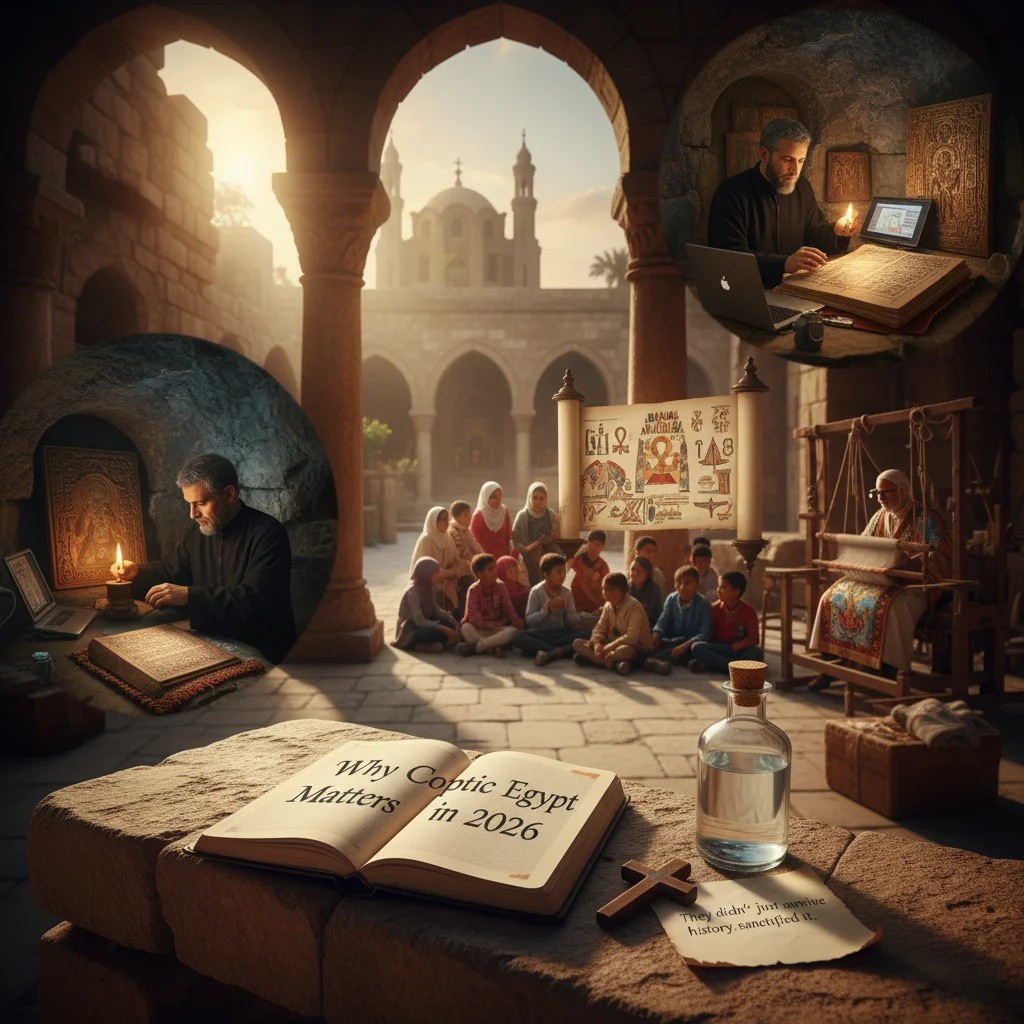
Continuing to emphasize that Egypt is the cradle of Christianity and home to some of the most important Coptic landmarks in the world, it also boasts the largest Christian community in the Middle East, with over 15 million Copts, representing 10 to 15 percent of the population.
Before embarking on this journey, you will need to familiarize yourself with a guide to Coptic Egypt for several reasons:
- Egypt is home to a major center of theology, specifically in the city of Alexandria, one of the earliest centers of Christian theology. In the second century AD, the School of Alexandria produced prominent theologians such as Origen and Clement.
- As for Coptic architecture, Egyptian Coptic churches combine Pharaonic, Greco-Roman, and Islamic styles, a unique blend unparalleled in the world.
- During your visit to many Coptic landmarks in Egypt, you will discover a glorious history of spiritual resilience that the Copts have endured for centuries. Their Coptic faith remains steadfast to this day, clearly evident in their monastic traditions.
Important information: In 2024, the Egyptian government launched the Coptic Heritage Preservation Initiative, a national project within spiritual tourism (Egypt Ministry of Tourism, 2024).
This Coptic Egypt travel guide 2026 honors that legacy—not as spectacle, but as sacred continuity.
2. The Coptic Calendar & Liturgical Rhythms

Here we will explain the Coptic calendar to help you enjoy your visit to Coptic sites:
- First: The Coptic calendar consists of thirteen months. The thirteenth month is called “Nasiya,” a festive month with celebrations lasting five to six days.
- Second: The main feasts are:
- Coptic Christmas, which falls on January 7th.
- Easter, which is celebrated according to the Julian calendar, meaning it follows the Western celebration.
- The Feast of the Cross, which falls on September 27th, commemorates the discovery of the True Cross.
- Third: The Coptic fast lasts between 210 and 240 days a year. This is one of the longest and most rigorous fasting periods, during which they abstain from animal products and dairy.
Important note: For a wonderful tourist and spiritual experience, schedule your visit for the Coptic Christmas period (January 7, 2026), when churches are illuminated and services are held at midnight.
This awareness is central to any Coptic Egypt travel guide 2026.
3. Cairo’s Coptic Heart: Old Cairo (Coptic Cairo)

We will discuss the sites located in Old Cairo:
- First: The Church of the Gallows: This is the Coptic Orthodox Church of the Virgin Mary. It was built in the 3rd century AD and renovated in the 9th century AD. The reason for its veneration is that it was built on the ruins of the Roman Babylon Fortress. Its nave is suspended between two towers, and it has 110 doors made of ivory and ebony with intricate carvings. It contains holy icons that appear to weep or glow, and it houses the patriarch’s throne. Modest clothing is required (head covering for women). Photography is permitted in the courtyard but not inside the sanctuary. The best time to visit is after 3:00 PM.
- Second: The Church of Saints Sergius and Bacchus (Abu Serga): This church is the place where the Holy Family stayed in a cave beneath the altar. It is one of the oldest churches in Egypt, having been built in the 4th century AD. It consists of Pharaonic columns that were reused as walls. For the best experience, you should descend into the church’s crypt. It is cold and dark, and it holds within it the details of the Holy Family’s journey, a journey of profound sanctity.
- Third: The Coptic Museum: Founded in 1910 by Marcus Simayka Pasha, this museum contains more than 16,000 artifacts, such as icons, manuscripts, textiles, and obelisks, which tell the story of 2,000 years of Coptic art. Among its most beautiful and important features is the sixth-century icon of Christ, fragments of tombs bearing Coptic and Greek inscriptions, and exquisite and beautiful textiles crafted by monks in Wadi El Natrun.
Tip: Hire a guide—the symbolism is rich and often unexplained (The Coptic Museum – Discover Egypt’s Monuments – Ministry of Tourism and Antiquities)
This trinity—church, cave, museum—forms the core of Coptic Egypt travel guide 2026 in the capital.
4. Beyond Cairo: Monasteries of the Desert

We will discuss the shrines and monasteries located in the desert:
The Egyptian desert is considered the cradle of Christian monasticism. In the third century, Saints Anthony and Paul withdrew to the Eastern Desert and became monks, the first to do so. They inspired many to follow this path, and this spiritual journey continues to this day. Examples of such places include:
- First: The Monastery of Saint Anthony (Eastern Desert): This monastery is located 334 km southeast of Cairo, near the Red Sea. It was built in 356 AD and is considered the oldest monastery in the world. The most beautiful aspect of visiting it is that it is surrounded by fortified walls adorned with 13th-century murals. It contains the Cave of Saint Anthony, which requires a two-hour hike up the mountain to reach. It also houses a library of ancient Coptic manuscripts. When visiting, only men are permitted to enter the monastery walls. Women can visit the outer church and the guesthouse, and they may also rest and recline, provided they obtain permission.
- Important information: Be sure to attend the sunset service, where the monks’ chants echo among the red sandstone cliffs.
- Second: The Monastery of St. Paul (near the Monastery of St. Anthony): This monastery was built in the 5th century AD near the cave where St. Paul lived as a hermit. The most remarkable aspect of visiting it is the miraculous spring that appeared during St. Anthony’s visits. It also features a refectory with communal wooden tables that are over a century old. Please note that entry is for men only; women may visit the outer areas.
- Third: The Monasteries of Wadi El Natrun (Western Desert): These monasteries are located 100 km northwest of Cairo. The most remarkable aspect of visiting them is that they contain four monasteries that are still standing: the Monastery of St. Bishoy, which houses the relics of St. Bishoy; the Monastery of Pope Shenouda III; and the Monastery of the Syrians (Deir al-Surian), famous for its Syriac and Coptic manuscripts. Please note that entry is permitted for both genders, but modest dress is advised.
Ethical Note: These are active monastic communities, not museums. Silence, modesty, and reverence are essential.
Desert monasteries are the soul of Coptic Egypt travel guide 2026—where solitude meets sanctity.
5. Alexandria: The Cradle of Christian Theology

Alexandria is considered the heart of Christianity in Egypt because it contains:
- First: St. Mark’s Coptic Orthodox Cathedral: This church was built in 1952. This is its new building, which replaced the old church built in the first century AD. The cathedral’s importance stems from the fact that it was the residence of the Coptic Pope until 2006, before he moved to Cairo. The most beautiful aspect of visiting it is attending Sunday Mass and witnessing the beauty of Coptic hymns in both Arabic and Coptic.
- Second: The Catacombs of Kom El Shoqafa: These catacombs are a blend of Egyptian and Greek art and reflect Christianity in its early period. The most beautiful part of visiting them is seeing the Hall of Caracalla, where Roman, Egyptian, and Christian art meet.
Alexandria reminds us that Coptic Egypt travel guide 2026 includes intellectual as well as spiritual roots.
6. A 5-Day Pilgrimage Itinerary: Your Coptic Egypt Travel Guide 2026 Blueprint.

Here’s a wonderful five-day itinerary:
- Day 1: The day begins with a walking tour of Coptic Cairo. We’ll start by visiting the Hanging Church and Abu Serga in the morning. At midday, we’ll visit the Coptic Museum, and in the evening, we’ll have dinner at Abu Tarek Koshari Restaurant, which is close to the Coptic sites.
- Day 2: The day begins with a spiritual visit to Wadi El Natrun to visit the monasteries of Anba Bishoy and the Syrian Monastery. We’ll return to Cairo in the evening.
- Day 3: We’ll travel to Alexandria and visit St. Mark’s Cathedral in the morning. At midday, we’ll visit the Coptic wing of the Library of Alexandria. In the evening, we’ll have dinner and stay overnight in Alexandria.
- Day 4: We’ll return to Cairo and visit the Church of the Virgin Mary in Zamalek, a modern Coptic architectural masterpiece, and attend Vespers.
- Day 5: We’ll visit the Ben Ezra Synagogue (Coptic Cairo), which is associated with the story of Moses.
This itinerary balances depth, logistics, and reverence—core to Coptic Egypt travel guide 2026.
7. Practical Guidance for Visitors (2026).

We will discuss a set of important tips and guidelines:
- First: Regarding clothing, women must wear long skirts with long sleeves, and wearing a headscarf is mandatory as it is required in churches. Men must wear long, discreet trousers. Shorts, sleeveless clothing, and large jewelry are strictly prohibited.
- Second: Photography is permitted in the outdoor areas of churches and museums, but prohibited during prayer. Permission must always be obtained before taking photographs.
- Third: Regarding transportation, Coptic sites in Cairo can be reached by taking the metro and getting off at Mar Girgis station, then walking a short distance. For visiting desert monasteries, you will need a private car with a licensed driver. It is recommended to book this through your hotel. Traveling to Alexandria will take approximately two hours by car or train.
- Fourth: Regarding language, it is preferable to speak Coptic inside churches if possible, but Arabic is the most common language. It is advisable to use common greetings such as “As-salamu alaykum” and “Shukran.”
These protocols honor the sanctity of your Coptic Egypt travel guide 2026 journey.
8. Ethical & Respectful Engagement.
We will discuss a set of etiquettes and ethical conduct that should be observed inside the church:
- First: If a service is being held, you must remain quiet and silent and refrain from taking photos out of respect for the sanctity of the place.
- Second: It is a wonderful idea to leave a small amount of money at the end of your visit as a social contribution to help maintain and continuously improve these places.
- Third: Some of the churches you will visit have exhibitions showcasing wonderful handmade works by Coptic artists. It would be a great idea to purchase these items as souvenirs.
As Pope Tawadros II says: “Our churches are not museums—they are homes.”
This philosophy underpins Coptic Egypt travel guide 2026.
9. When to Visit Coptic Sites in 2026.
| Time | Experience | Considerations |
| January (Coptic Christmas) | Liturgies, decorations, community joy | Book hotels early; churches crowded |
| April–May (Post-Easter) | Calm, reflective atmosphere | Ideal for monasteries |
| September (Feast of the Cross) | Special hymns, processions | Smaller crowds than Christmas |
| Avoid: Great Lent (March–April) | Strict fasting; limited visitor access | Churches still open, but subdued |
Timing your visit deepens your Coptic Egypt travel guide 2026 experience.
10. Safety & Accessibility.
- General Safety: Coptic sites are well-protected; Tourist Police are present in Coptic Cairo.
- Women Travelers: Safe in Coptic Cairo; desert monasteries have gender restrictions (respected, not punitive).
- Health: Carry water and a light scarf—churches are cool, but streets are hot.
Egypt welcomes Christian pilgrims with care—a key assurance of Coptic Egypt travel guide 2026.
11. Common Misconceptions Debunked.
There are some misconceptions that need to be corrected:
- Incorrect: Copts are a minority sect.
- Correct: They are not a minority; rather, there is a large sect that constitutes the majority of them, which is the Orthodox sect, and they are closely affiliated with the Eastern Orthodox Church.
- Incorrect: Coptic churches are not just tourist attractions.
- Correct: Coptic churches are still active places of worship, so visit them with humility.
- Incorrect: You must be a Christian to visit them.
- Correct: Non-Christians are welcome, provided they observe appropriate behavior due to the sanctity of the place.
Clarity like this is vital to Coptic Egypt travel guide 2026.
12. Final Reflection: Walking in the Footsteps of the Holy Family.
To journey through Coptic Egypt is to walk where Mary rested, where Anthony prayed, and where Mark preached. It is to witness a faith that has survived empire, persecution, and time—not with noise, but with quiet, unshakable grace.
In 2026, as the world seeks authenticity, Coptic Egypt offers not just history, but living truth. Let this Coptic Egypt travel guide 2026 be your companion—not to see, but to see with understanding.
Recommended Resources & Contacts (2026).
- Coptic Orthodox Church – Official Site:
Home – Coptic Orthodox Church - Coptic Museum – Visitor Info:
The Coptic Museum – Discover Egypt’s Monuments – Ministry of Tourism and Antiquities) - Egypt Ministry of Tourism – Coptic Heritage Trail:
https://www.egypt.travel/coptic - UNESCO – Coptic Monasteries of Wadi El Natrun:
https://whc.unesco.org - Pilgrimage Office – St. Anthony Monastery:
+20 100 123 4567 (call for men’s overnight requests)
Follow us on:
Articles that might interest you :
A Family Trip to Egypt with Children: What to Do, What to Avoid? A Safe and Fun Guide 2026.